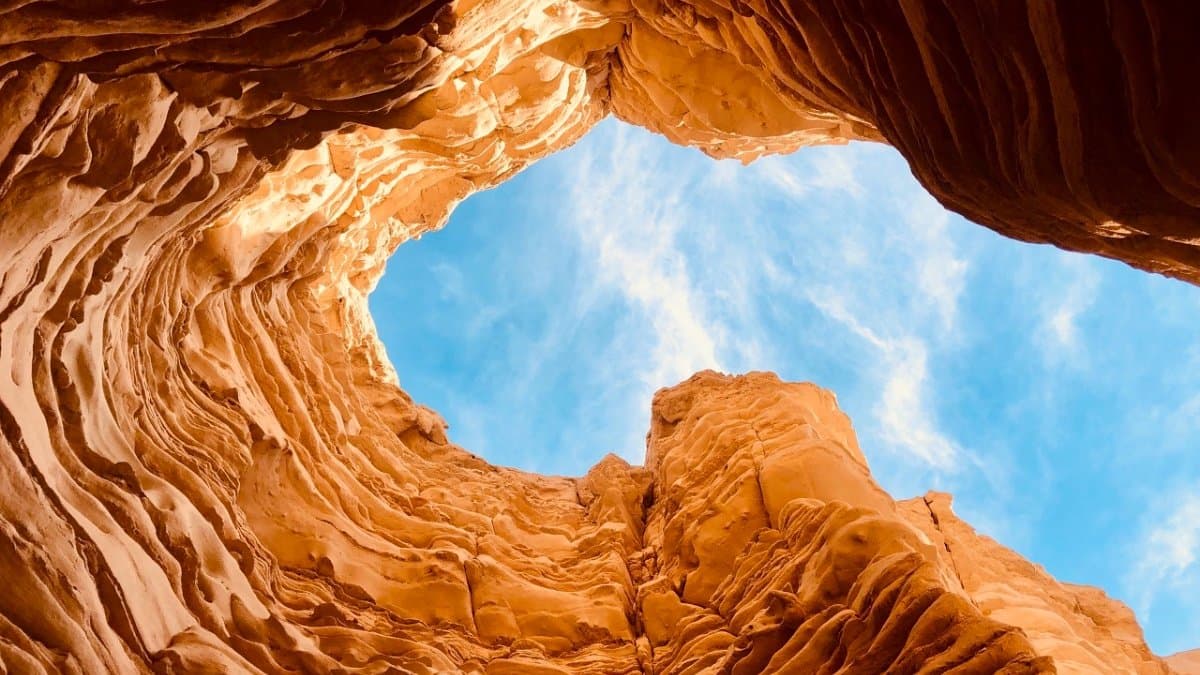
Why East Xinjiang? Because Nobody Goes There
Xinjiang gets split in two by the travel industry — and honestly, by most Chinese travellers too. North Xinjiang gets the Instagram crowd: Kanas Lake, Hemu Village, those golden birch forests that turn the internet yellow every September. South Xinjiang gets the culture seekers: Kashgar's Old City, the Sunday livestock market, mosques and minarets against a desert backdrop. Both are extraordinary. Both are also, at this point, well-documented. But East Xinjiang? East Xinjiang gets forgotten. It's treated as a transition zone, a stretch of highway you drive through on the way to somewhere more photogenic. I'd been guilty of this myself — I'd crossed through Turpan on a previous trip and barely registered it beyond "hot, grapes, that Flaming Mountain thing from Journey to the West." That was a mistake. Because East Xinjiang, it turns out, contains the most dramatic landscape I've ever driven through, some of the most important Silk Road ruins in China, and a no-man's-land crossing that made my jaw actually drop. The route: Urumqi to Turpan, then south into the desert for a two-day 4WD crossing of the Dahaidao (大海道, literally "Great Sea Route"), up over the East Tianshan mountains to Barkon Lake, and finishing at Jiangbulake's rolling grasslands before returning to Urumqi. Seven days. One complete loop around the East Tianshan range. A journey from scorched desert to alpine meadow and back, with three thousand years of Silk Road history threaded through every stop.
Find flights to Urumqi — your starting point for East Xinjiang adventures.
Prices compared via Trip.com. We may earn a commission at no extra cost to you.
Search FlightsDay 1: Arrival in Urumqi — The Gateway
I flew in from Shanghai on an evening flight — four and a half hours, and by the time I landed at Urumqi Diwopu Airport, Beijing time said 10pm but the sun was still setting. Xinjiang runs on unofficial local time, two hours behind Beijing, and your body knows it even if your phone doesn't. The hotel was a proper five-star in the city centre (the kind of place where everything works and the breakfast buffet has both congee and croissants), and after checking in I walked out to find lamb skewers on the street. Urumqi at midnight is alive in a way that most Chinese cities aren't — smoke from charcoal grills, the smell of cumin and chilli powder hanging in the air, clusters of people eating naan bread and drinking beer under neon signs in Arabic and Chinese. The trip hadn't started yet, but Xinjiang was already making its case. The evening briefing was straightforward: our guide — a product designer turned trip leader who'd spent 23 days solo-driving East Xinjiang the previous year — laid out the week ahead. "The first half is about history and desert," he said. "The second half is about mountains and freedom. And in the middle, there's the Great Sea Route, which is about questioning what planet you're on." I liked the sound of that.
Book left-side window seats on flights to Xinjiang — the flight path follows the Tianshan mountain range and the aerial views are spectacular, especially at sunset.
Day 2: Karez Wells, Gaochang Ruins, and Kumtag Desert at Sunset
We left Urumqi at 8am and drove two and a half hours southeast into the Turpan Basin — the second-lowest point on Earth after the Dead Sea, and in summer, one of the hottest inhabited places on the planet. Even in spring, stepping out of the air-conditioned bus felt like opening an oven door. First stop: the Karez wells (坎儿井). I'll admit I wasn't expecting much — underground irrigation sounds like the kind of thing that's historically significant but tediously dull to actually visit. I was wrong. The Karez system is a network of hand-dug underground channels that carries snowmelt from the Tianshan mountains across dozens of kilometres of scorching desert to irrigate Turpan's grape orchards and cotton fields. Some of these channels are over two thousand years old. Walking through the underground tunnels, with cool water flowing silently past your feet and the temperature dropping twenty degrees from the surface, you feel the engineering genius physically. These people solved the impossible: they made a furnace bloom. The guide was good on this — he explained how each vertical shaft was dug at precise intervals, how the gradient was calculated without modern instruments, how the entire system predates anything comparable in Europe by centuries. I stood in one of the deeper tunnels and thought about the generations of workers who'd carved this out of solid earth, in darkness, in heat, for a future they'd never see. That's civilisation.
Gaochang: A Silk Road Capital in Ruins
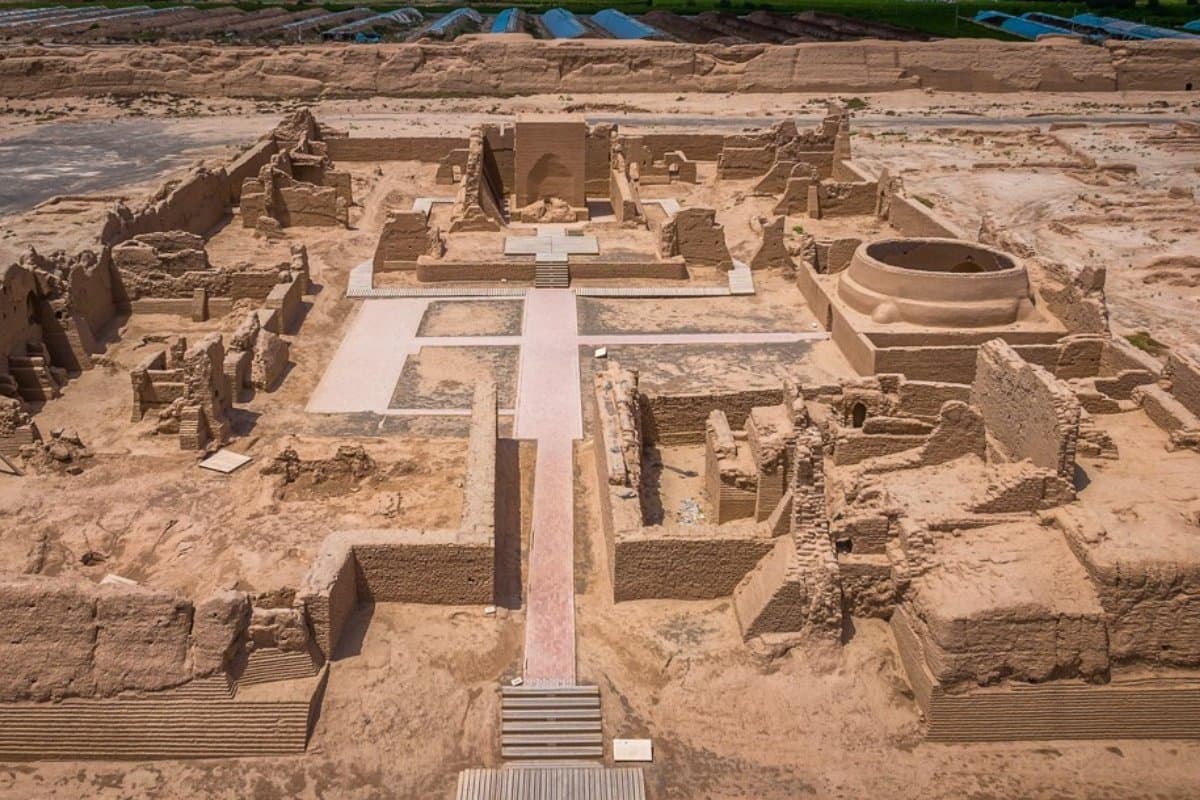
From the Karez, we drove to Gaochang (高昌故城), and this is where the Silk Road stopped being an abstract concept and became something I could walk through. Gaochang was once the political and cultural capital of the western Silk Road — a walled city of 200,000 people at its peak, where Buddhist monks studied alongside Manichaean priests and Nestorian Christians, where Xuanzang himself stopped to preach on his legendary journey to India. Now it's ruins. Crumbling mud-brick walls baking in the sun, the outlines of streets and buildings still visible, watchtowers reduced to stumps. But the scale is staggering — this was a proper city, not a small outpost, and walking through its silent streets with the Flaming Mountains glowing red in the background, I felt the weight of what had been lost. An entire civilisation, built on trade and tolerance, erased by time and war and the slow encroachment of desert sand. Our specialist guide traced the city's history from its founding in the 1st century BCE through its golden age under the Tang Dynasty to its destruction by Genghis Khan's armies in the 13th century. Standing in the remains of what was once a Buddhist temple, he pointed out fragments of painted plaster still clinging to the walls — flecks of blue and gold that had survived eight hundred years of exposure. You listen, and the wind sounds different here. Like it's carrying something.
Kumtag Desert: Where Sand Meets the City
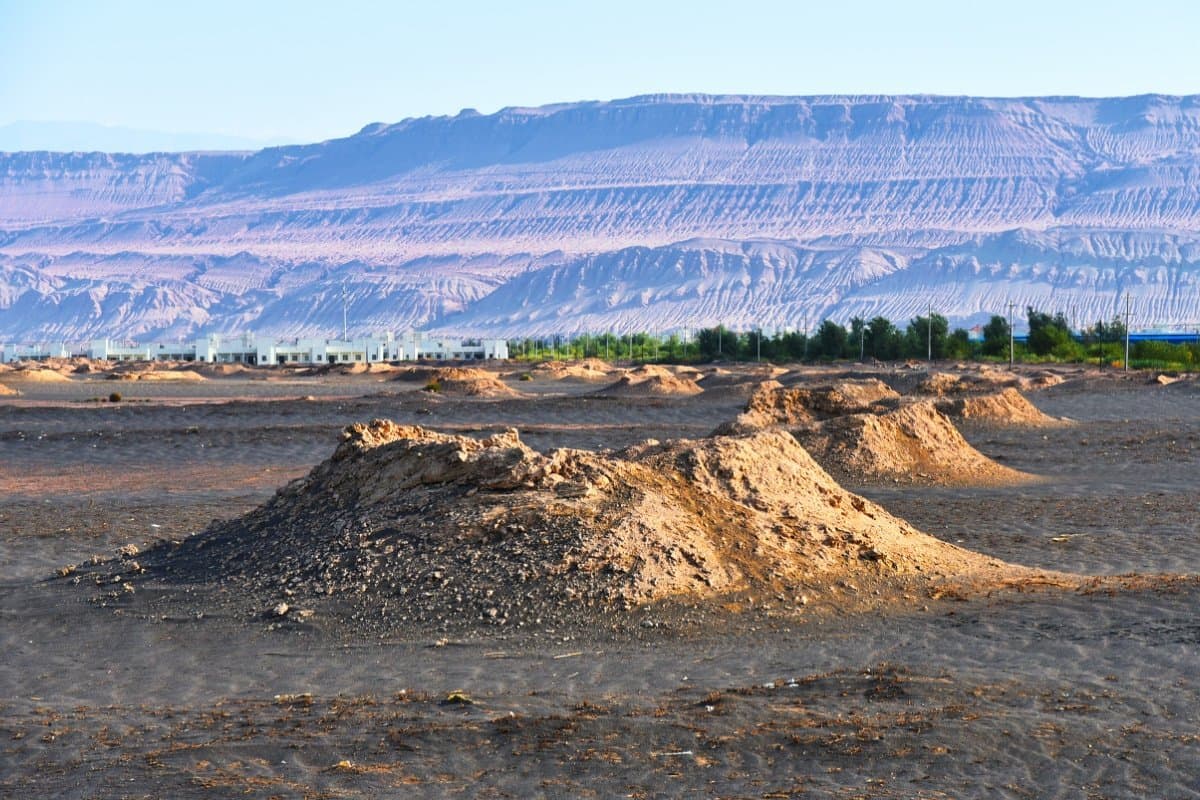
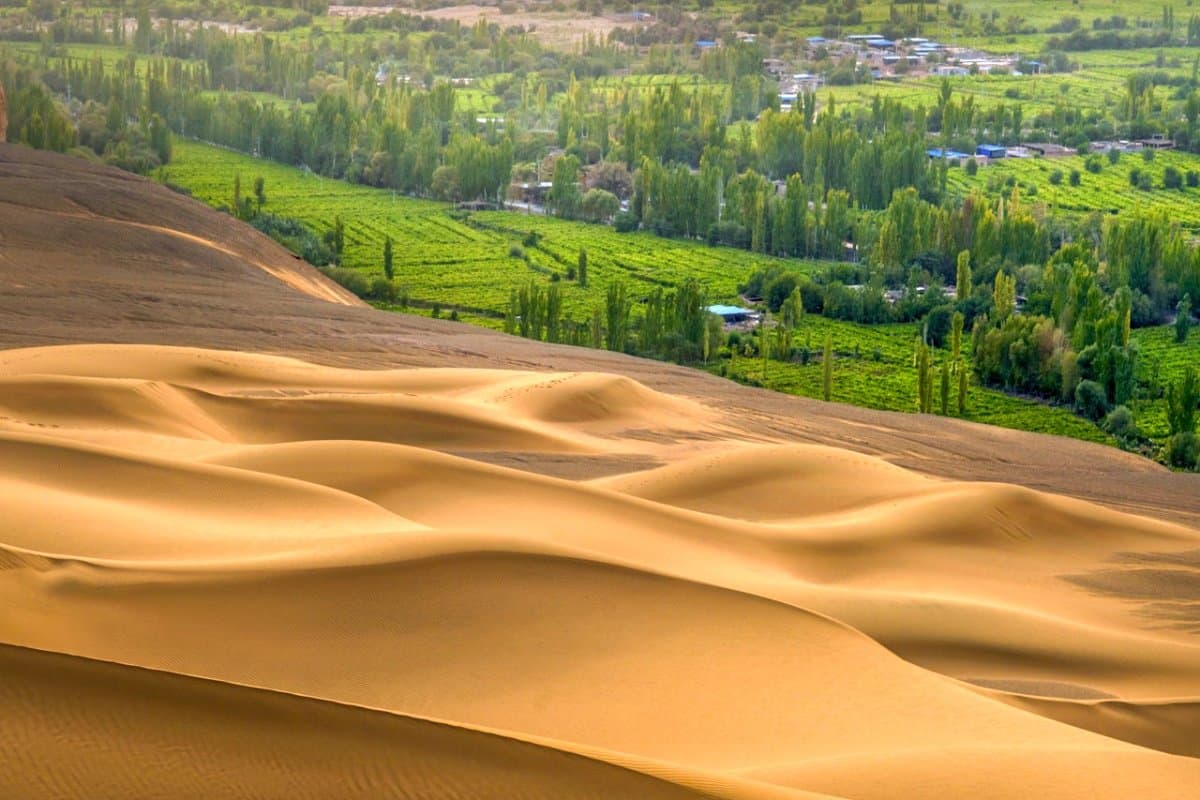
We drove along the base of the Flaming Mountains — an hour and a half of scorched red rock that genuinely looks like it's on fire in the afternoon light — and arrived at Kumtag Desert (库木塔格沙漠) in the late afternoon. Kumtag holds an almost absurd distinction: it's the closest desert to a city in the world. You're standing on the edge of Shanshan county town, shops and apartment buildings behind you, and in front of you is an ocean of sand dunes stretching to the horizon. No transition, no buffer zone — just civilisation on one side and raw desert on the other. We entered at golden hour, and the light was doing things I've only seen in Sahara photographs. The dunes cast shadows so sharp they looked drawn. The sand shifted between gold, copper, and deep amber as the sun dropped. In the distance, the green strip of the oasis town was visible through the heat shimmer, and the contrast was almost surreal — lush trees and irrigated fields right next to pure, waterless desert. I climbed a dune barefoot (shoes fill with sand in seconds) and sat at the top watching the sunset. The sand was still warm from the day's heat. Below me, a few other travellers were scattered across the dunes, tiny figures in an enormous landscape. Nobody was talking. Everyone was just watching. When the sun finally dipped below the horizon, the sky went through every shade of pink and purple, and the desert turned blue. That was the moment I understood what East Xinjiang was offering — experiences that feel like they belong on a different planet, in a region that most travellers drive straight through.
Days 3–4: The Great Sea Route — Two Days in No-Man's-Land
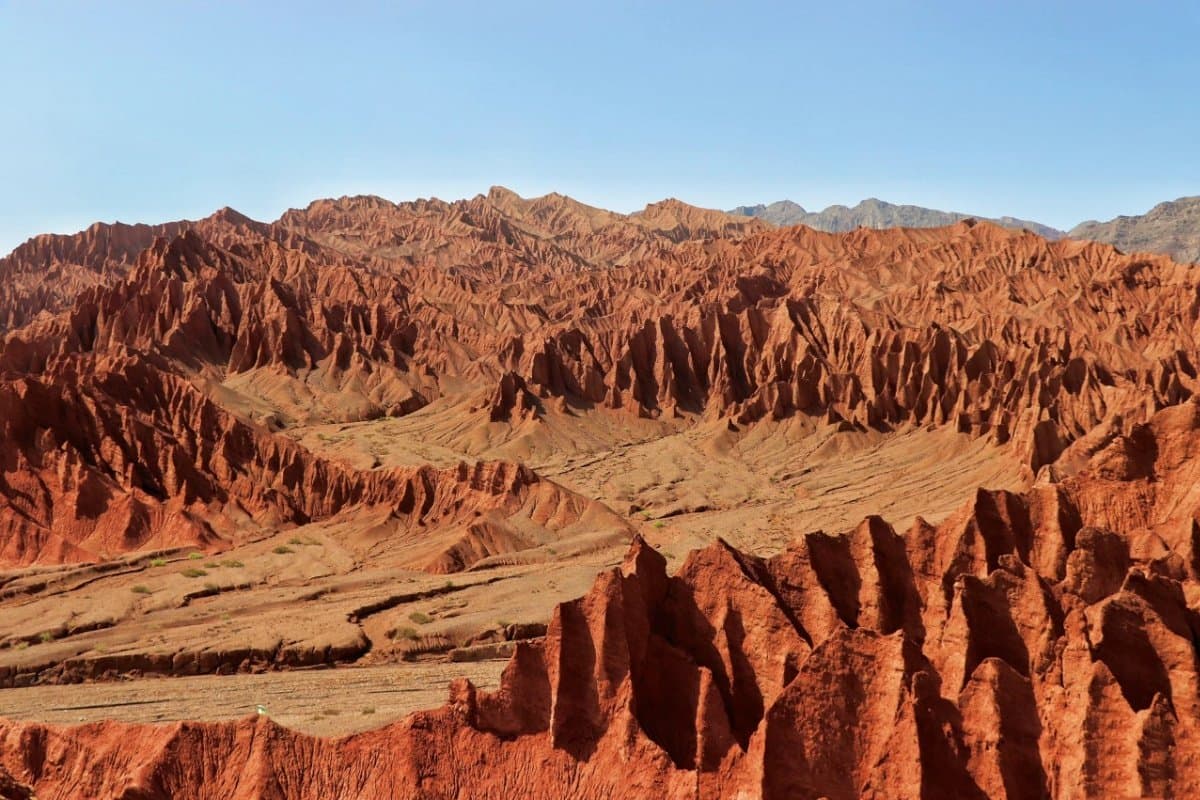
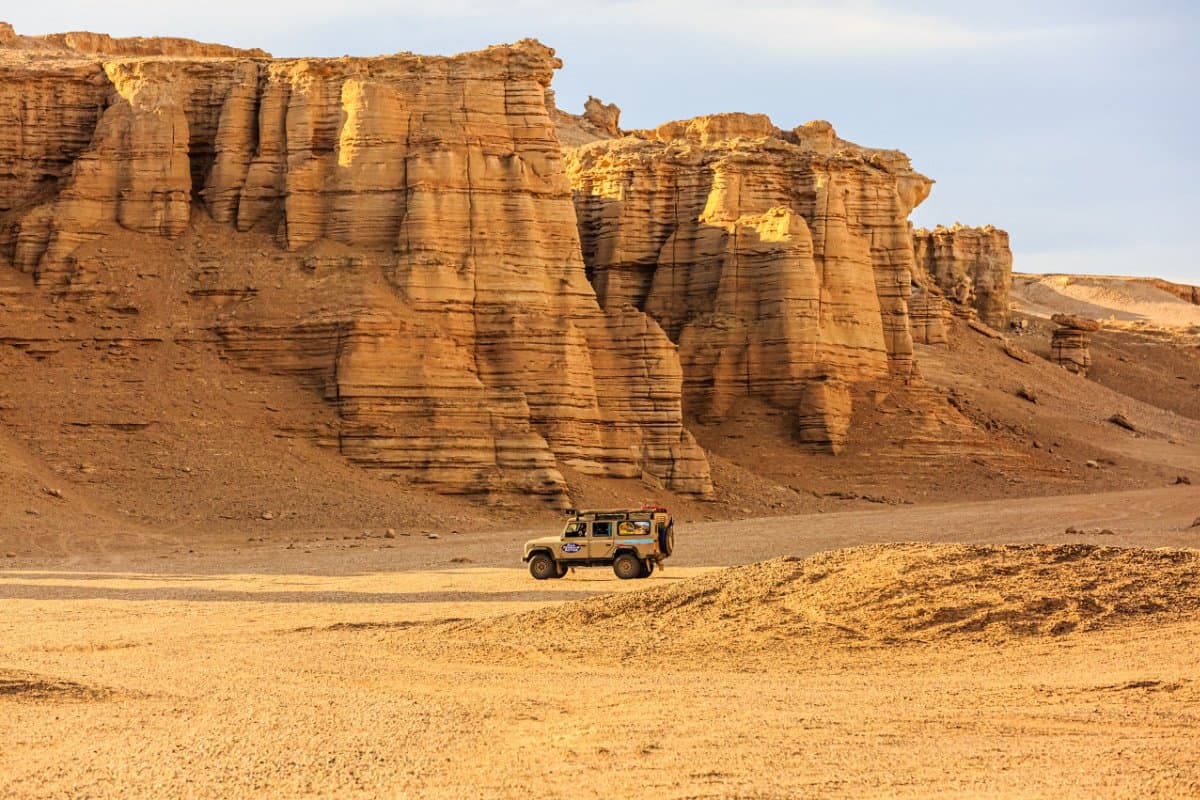
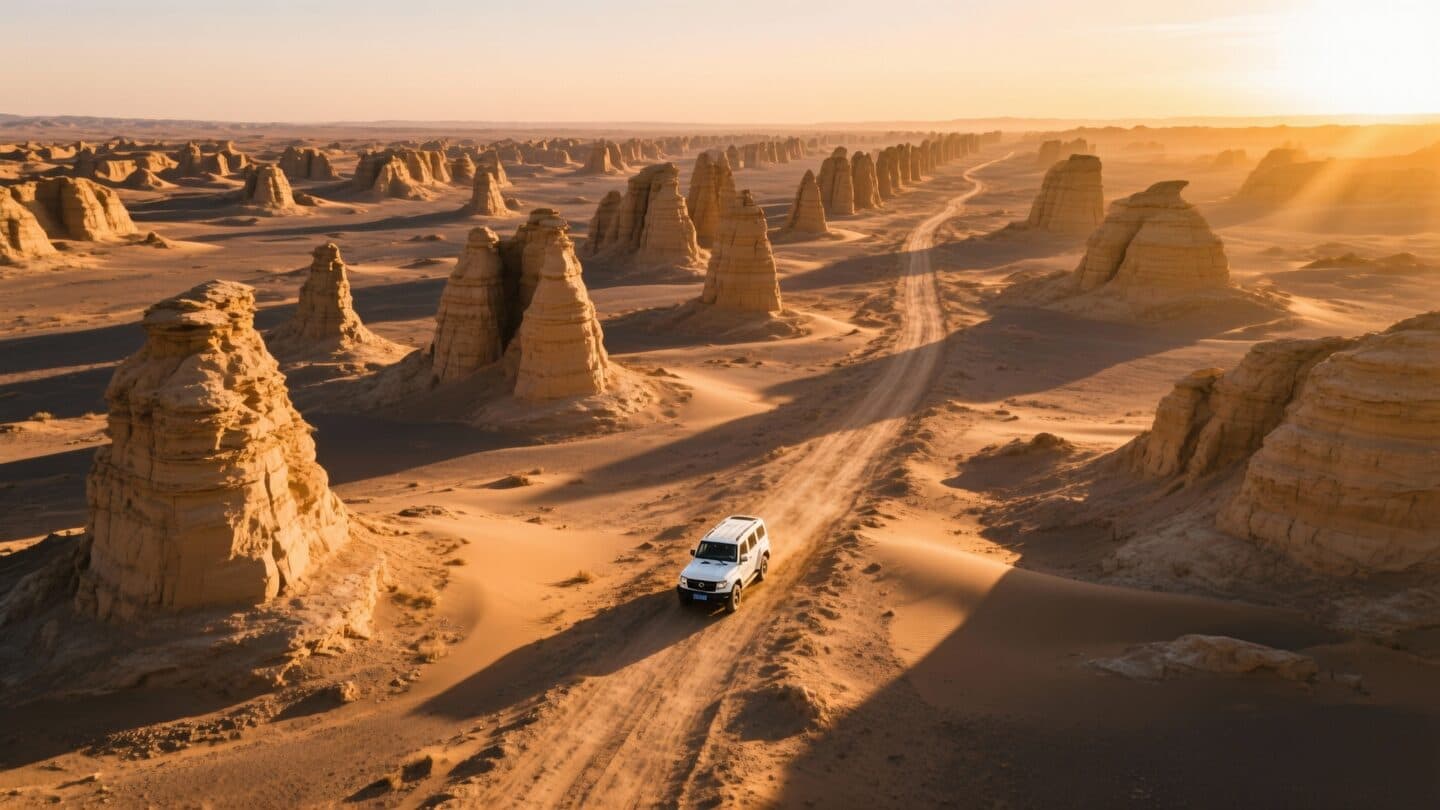
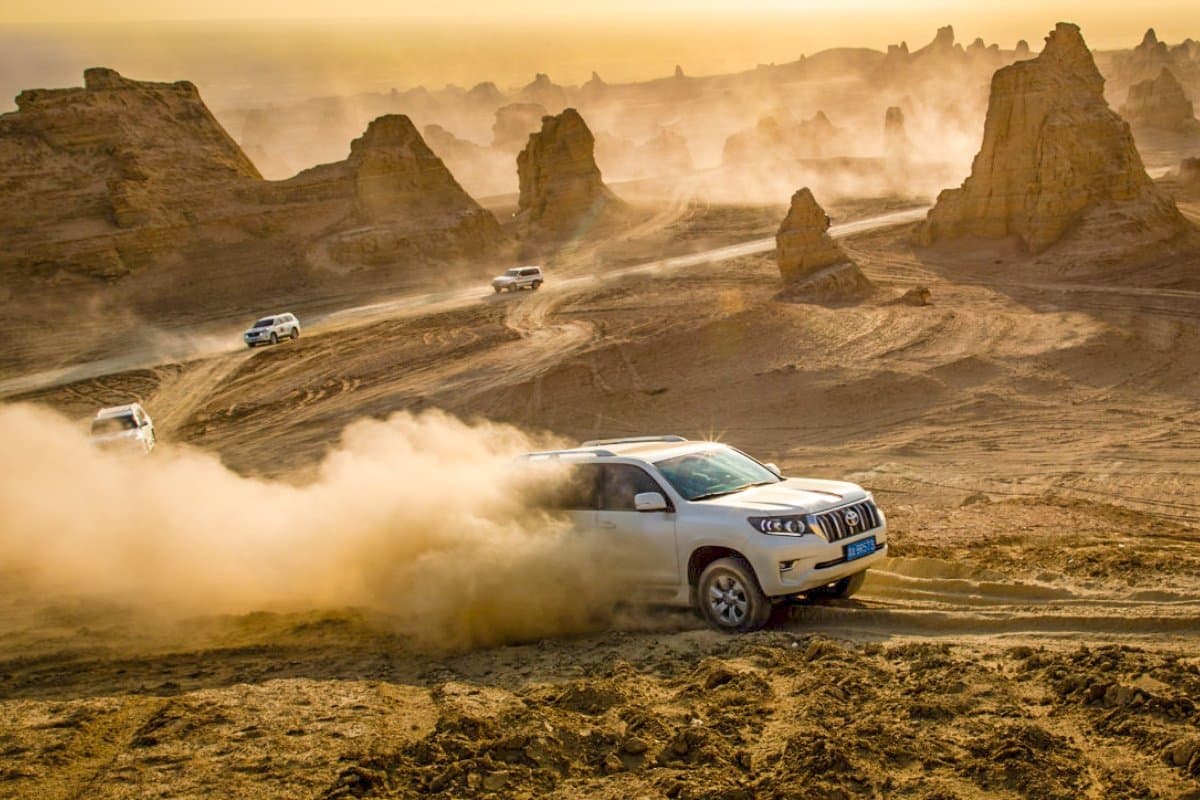
If the rest of the trip was appetiser, the Dahaidao (大海道) was the main course. And what a course it was. The Great Sea Route is China's only no-man's-land that civilians can legally cross. It sits between Shanshan and Hami, a vast tract of uninhabited desert studded with yardang formations — wind-eroded rock pillars, mesas, and ridges that look like they were designed by a science fiction concept artist. The name "Great Sea Route" comes from the ancient Silk Road traders who crossed this stretch and described the experience as navigating a "vast, turbulent sea" of sand and stone. They weren't exaggerating. At a staging point outside Shanshan, we transferred from our bus into 4WD Toyota Land Cruisers — four passengers per vehicle, professional off-road drivers at the wheel. Our regular luggage went back to Hami by road; we carried only daypacks with water, sunscreen, and layers for the desert night. This is not a drive you take in a sedan. There are no paved roads, no signposts, no fuel stations, no cell service. Just tracks worn into the earth by previous 4WDs, and a satellite phone for emergencies. The first hour was gravel plains — flat, monotonous, the kind of landscape that makes you think "is this it?" And then the yardangs started. At first they were small — weathered humps of stone poking out of the desert floor. Then they got bigger. And bigger. Until we were driving through a forest of towering rock formations, some of them thirty metres tall, carved by wind into shapes that ranged from vaguely architectural to genuinely alien. Pillars, arches, mushroom-shaped mesas, walls of layered sediment in bands of rust, cream, and charcoal.
The "Great Wall" and the "Eye of Lop Nur"
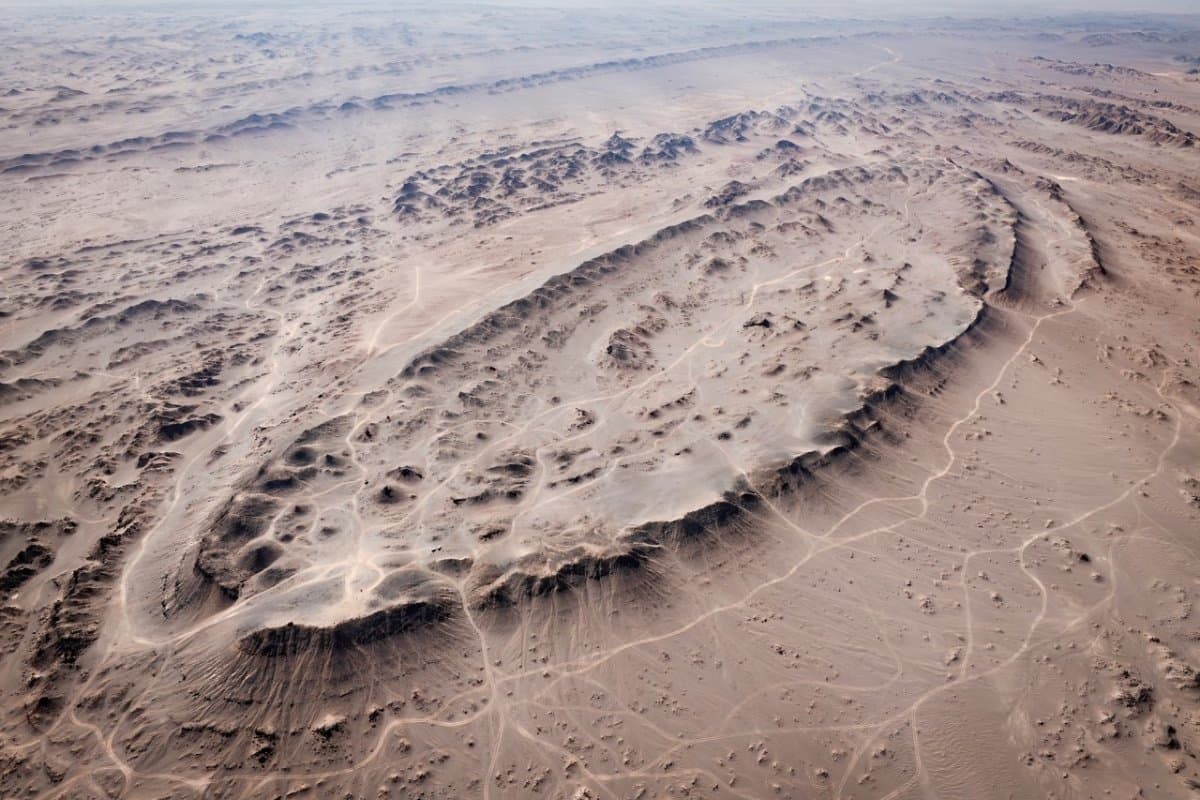
The drivers took us deep into the no-man's-land core — areas that ordinary tourists simply cannot reach. The highlight of day one was what the guides call the "Great Wall of the Wilderness" (绝境长城) — a continuous ridge of yardang formations that stretches for kilometres, the eroded rock faces forming a wall-like barrier that, from certain angles, genuinely resembles a ruined fortification built by giants. Nearby, a circular depression in the desert floor is nicknamed the "Eye of Lop Nur" (罗布泊之眼), a reference to the infamous dried lake bed further west where the explorer Peng Jiamu vanished in 1980. I flew my drone from inside a formation called "Tongtian Cave" (通天洞) — a natural tunnel through a massive yardang pillar — and as the camera climbed out of the cave mouth and the full expanse of Dahaidao revealed itself, I felt a chill run through me despite the 40°C heat. It was the scale. From ground level, you see individual formations. From the air, you see that there are thousands of them, stretching in every direction to the horizon, and beyond that more horizon. This "ancient sea" swallowed entire Silk Road caravans. Standing there, you understand how. We spent hours exploring — scrambling over rock formations, photographing impossible erosion patterns, finding small caves and arches that the drivers knew from years of crossings. Nobody was in a rush. There was literally nobody else out there. No phone signal, no noise pollution, no light pollution. Just rock, sand, wind, and sky.
Sleeping in the Desert: The Only Hotel in No-Man's-Land
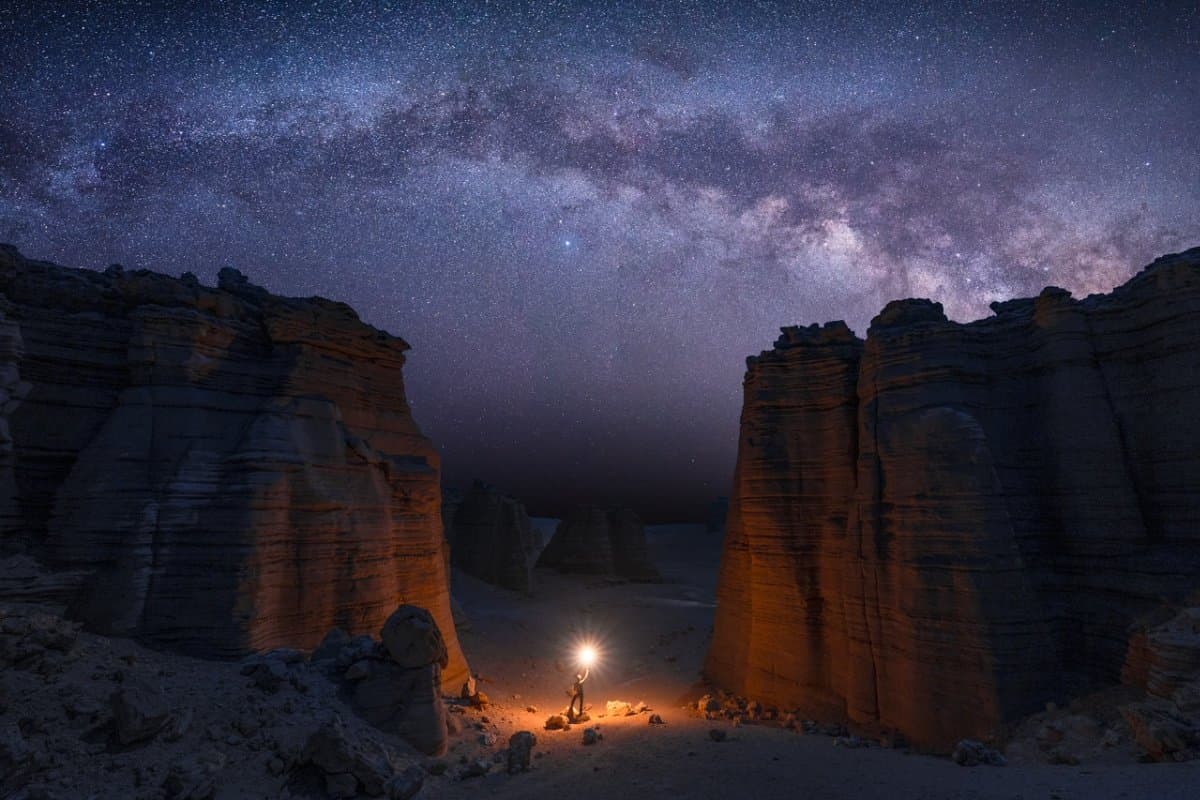
Night one was spent at the only hotel in the entire Dahaidao area — a basic but functional lodge at Red Willow Beach (红柳滩), deep in the desert. Three-star at best. The rooms were clean, the showers worked, and there was food — which, after a full day of bouncing around in a 4WD, felt luxurious. But the real amenity was outside. I walked out of the hotel after dinner and looked up. The Milky Way was a physical band across the sky, dense and bright in a way that I've only seen in rural Africa and high-altitude Tibet. Yardang formations stood in silhouette against the star field like ancient sentinels. There was no sound. Not a hum, not a rustle, not the distant drone of a highway. Absolute, total silence, the kind that rings in your ears because your brain doesn't know what to do with it. I sat on a rock for an hour, just looking up. A couple of other travellers came out and we nodded at each other but didn't speak. There are moments in travel where words feel inadequate and unnecessary, and this was one of them. The desert at night is a cathedral with no roof and no walls and no congregation except whoever happens to be standing in it.
There's no phone signal for most of the Dahaidao crossing. The vehicle convoy carries a satellite phone for safety. Tell your family you'll be off-grid for two days before you enter. Also: bring motion sickness medication — there are zero paved roads and the terrain is genuinely bumpy.
Day 5: Crossing East Tianshan — Desert to Grassland in Three Hours
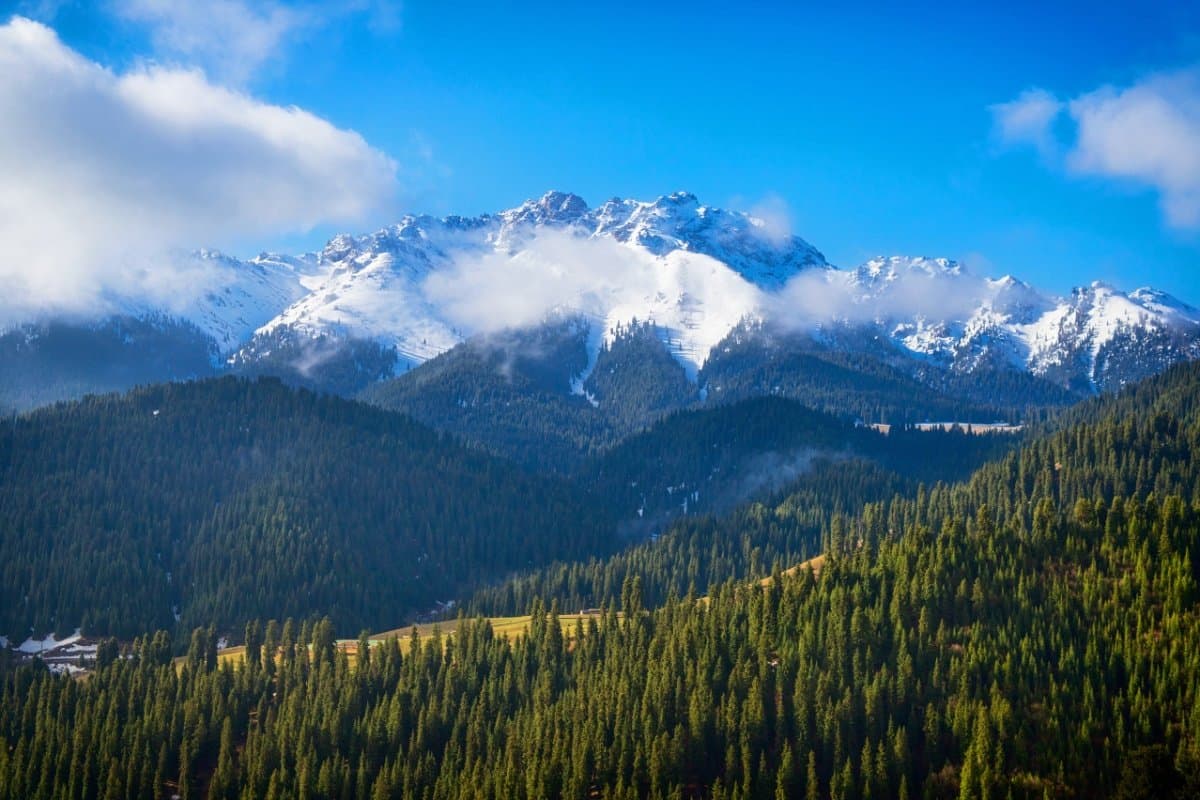
After completing the Dahaidao crossing and arriving in Hami on day four afternoon, day five delivered the trip's most dramatic geographical twist. We drove north from Hami towards Barkon (巴里坤), which meant crossing the East Tianshan mountain range — and the transformation was so rapid and so extreme that it felt like driving through a portal into a different country. The road started in classic Hami desert — dry grassland, gravel plains, the kind of landscape where you can see fifty kilometres in every direction and there's nothing in any of them. Then the elevation began to climb. Dry grass gave way to scrubby bushes. Bushes gave way to Tianshan spruce forest, dense and dark and dripping with moisture, utterly incongruous after days of desert. The temperature dropped fifteen degrees. I could smell wet earth and pine needles through the open window. And then — one particular mountain pass — the forest opened up and the north side of the Tianshan range revealed itself in a single, breathtaking panoramic sweep: rolling alpine meadows, distant snow peaks, herds of horses grazing by a river, and a sky full of towering cumulus clouds casting shadows that raced across the grassland. I actually said "oh my god" out loud, and I don't normally do that. Three hours earlier we'd been in a furnace. Now we were in something that looked like the Scottish Highlands crossed with the Swiss Alps. The geography of Xinjiang is fundamentally unfair — one mountain range should not be allowed to contain this much contrast.
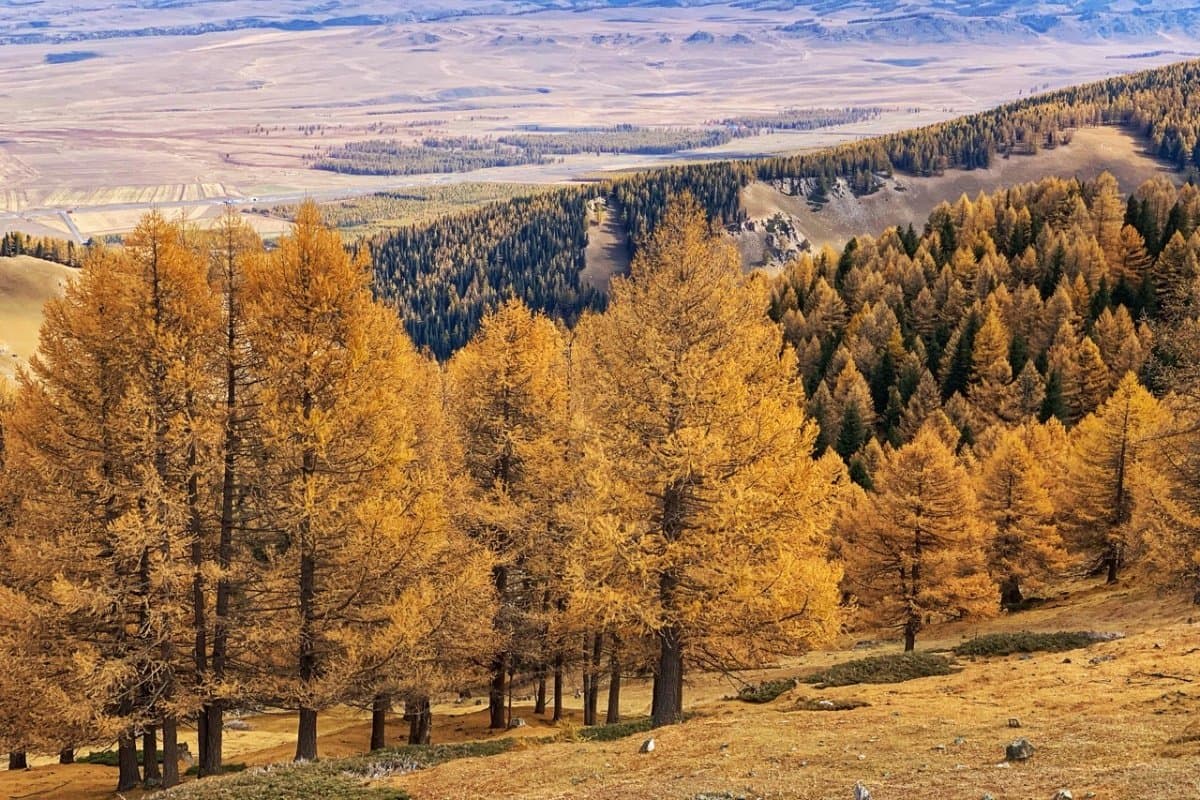
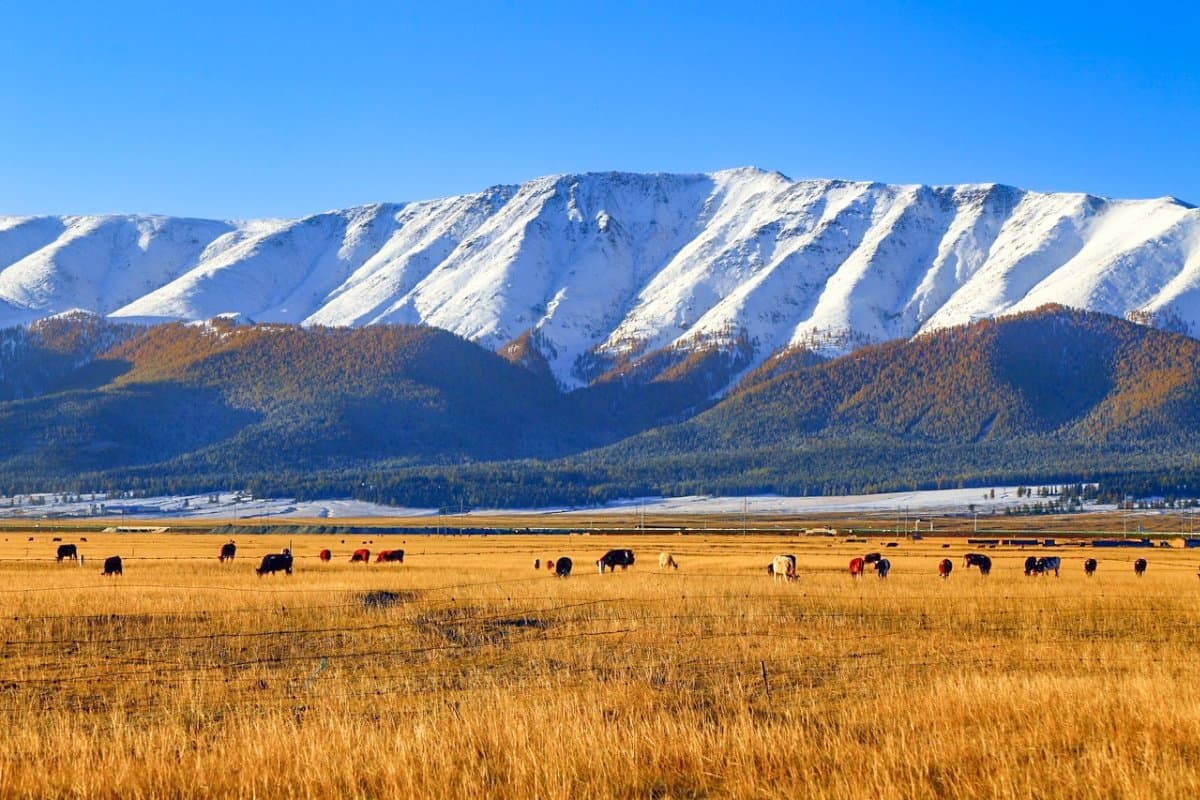
Barkon Lake (巴里坤湖) was the afternoon stop. This was once one of Xinjiang's "Three Great Trading Cities," as important as Urumqi and Ili in its heyday. Caravans on the northern Silk Road corridor would arrive here after crossing the Tianshan passes, resupply, and rest before continuing west. The trading post is gone. What remains is a vast wetland surrounded by grassland, with Kazakh herders grazing horses and sheep against a backdrop of snow-capped mountains. Old beacon towers — the Silk Road's communication network — dot the landscape, crumbling but still standing after centuries. We walked along the lakeshore for an hour. The grass was soft underfoot. Horses lifted their heads to watch us pass, then went back to grazing. A hawk circled overhead. After days of barren desert and no-man's-land, the lushness of this place felt almost overwhelming — the green was so vivid it looked artificial. But it wasn't. This is what the ancient Silk Road traders felt when they emerged from the desert crossing and reached Barkon: the relief of water, grass, and life after days of stone and sand. That emotional arc — desolation to paradise — is exactly what this route delivers, and it's as powerful now as it must have been a thousand years ago.
Day 6: Jiangbulake — The Poem After the Epic
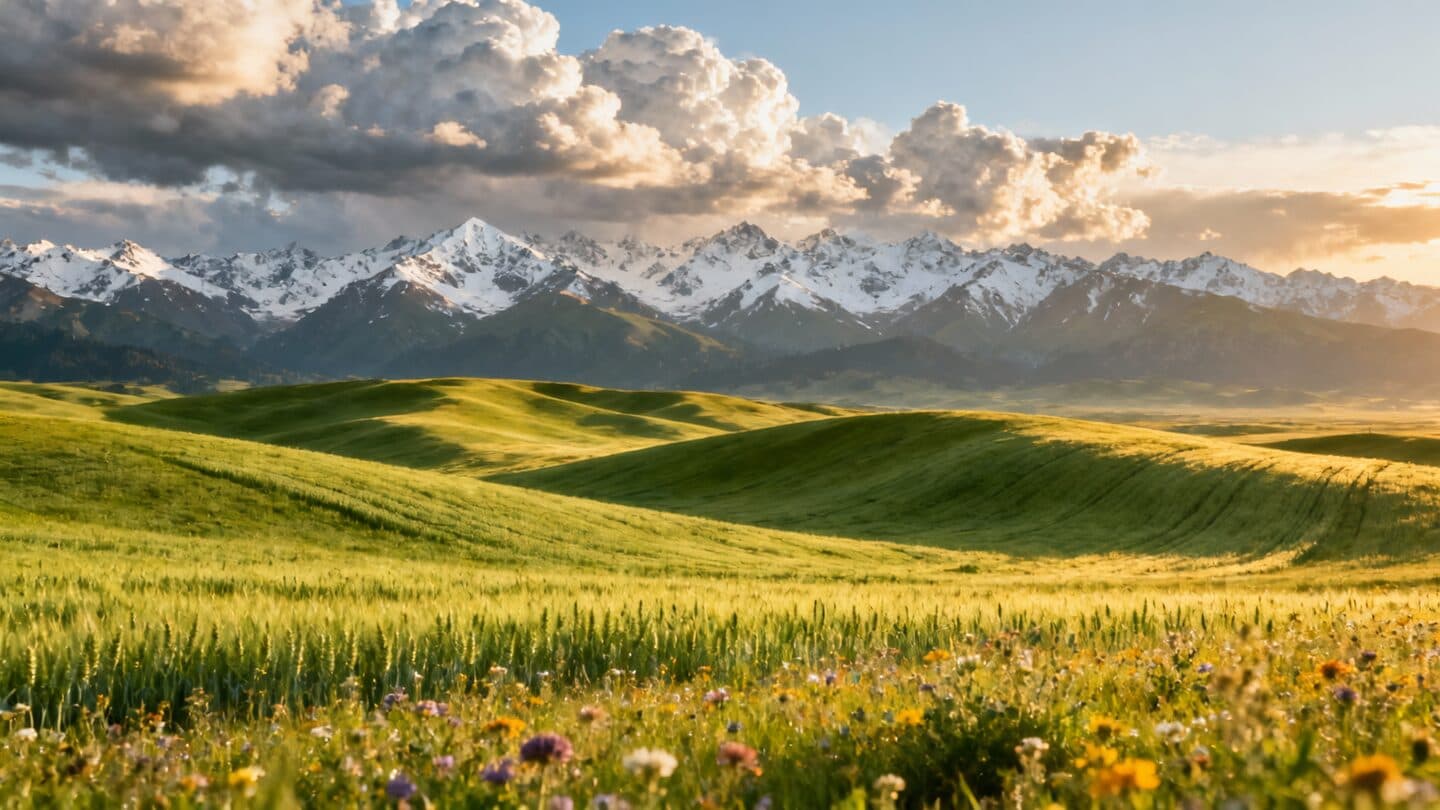
If the Dahaidao crossing was a heavy metal album — all raw power, volume, and drama — then Jiangbulake (江布拉克) was the acoustic set that followed. We drove an hour from Qitai county to this grassland park at the foot of the Tianshan's northern slopes, and the mood of the entire group shifted audibly. People stopped exclaiming and started sighing. The landscape had that effect. Jiangbulake means "Holy Water Spring" in Kazakh, and the place lives up to its name. Rolling hills covered in wheat fields that ripple like ocean waves in the wind. Tianshan spruce climbing the mountain slopes. Snow peaks floating above the treeline. Wildflowers — yellow, purple, white — scattered through the grass in patterns that no garden designer could improve on. Locals call it "Little Altai" (阿勒泰东天山分泰), and I get why — it has the same dreamy, time-suspended quality as Altai's famous valleys, but without the tourist infrastructure or the crowds. The trip leader had chartered a private vehicle for the group to explore the park — a smart move, because Jiangbulake is sprawling and the attractions are scattered. We stopped wherever someone spotted a view, which was approximately every three minutes. A field of wheat with mountains behind. A lone tree on a hilltop. A Kazakh yurt with smoke drifting from its chimney. Every stop was a postcard. Every postcard was better than the last. I spent the afternoon sitting in the grass at the highest viewpoint, eating a naan bread I'd bought from a roadside vendor, watching clouds build and dissolve over the snow peaks. The bread was warm. The wind smelled like cut grass. In the distance, a hawk was working the thermals. For the first time in a week, nobody was talking about the next destination. Everyone was just... here. Present. Quiet. That's what Jiangbulake does — it slows the clock down and reminds you that the best travel moments are often the ones where nothing is happening at all.
Book hotels in Urumqi — the best base for starting your East Xinjiang adventure.
Prices compared via Trip.com. We may earn a commission at no extra cost to you.
Compare HotelsWhat This Route Taught Me About China
I've been travelling China for years — I've done the big cities, the famous mountains, the obligatory Great Wall hike. But this week in East Xinjiang recalibrated my understanding of the country in a way that nothing else has. First: the scale. China contains landscapes that rival anything on Earth — Mars-like deserts, Alpine grasslands, underground engineering marvels, ruined empires — and many of them sit in regions that get almost zero international attention. The Dahaidao alone would be a headline attraction in any other country. Here, it's barely known outside of off-road enthusiast forums. Second: the depth. The Silk Road isn't a museum exhibit in Xinjiang — it's a living geography. You walk through the same passes, shelter from the same winds, drink water from the same snowmelt-fed systems that Xuanzang, Marco Polo, and countless anonymous traders used for centuries. The history is physical and present in a way that reading about it never captures. Third: the contrast. No single route I've ever travelled has delivered such extreme environmental shifts — from 40°C desert to 10°C alpine meadow, from Mars to Switzerland, from scorched ruin to living grassland — in such a compact distance. East Tianshan is one of the most geographically dramatic mountain ranges on the planet, and crossing it is an experience that rewires your sense of what's possible. This isn't a route for everyone. It's remote, the desert sections are genuinely challenging, the hotels outside Urumqi are basic, and you need a tolerance for long drives and no cell service. But if you're the kind of traveller who's bored by the obvious and hungry for the authentic — if you want to see a side of China that even most Chinese people haven't experienced — East Xinjiang is waiting. It's been waiting for a thousand years.
Practical Info: Planning Your East Xinjiang Trip
Here's what you need to know to plan this route: - **Getting there**: Fly to Urumqi (URC). Direct flights from Shanghai, Beijing, Guangzhou, Chengdu, and many other Chinese cities. Some international flights via Central Asian hubs. - **Best season**: Late April through October. May–June and September are ideal — warm but not scorching. July–August can exceed 45°C in the Turpan Basin. - **Duration**: 7 days is the sweet spot for this loop. Shorter trips can cover Turpan + Dahaidao without the northern Tianshan section. - **Budget**: Group tours run ¥6,980–7,980 ($960–1,100) including all transport, hotels, 4WD crossing, park entries, and guide fees. Independent travel is possible but you'll need to arrange your own 4WD and driver for Dahaidao (roughly ¥2,000–3,000/vehicle/day). - **Accommodation**: 5-star in Urumqi, 4-star equivalent in county towns (Shanshan, Hami, Qitai), 3-star at the Dahaidao desert hotel. Pack expectations accordingly for the desert nights. - **Food**: Xinjiang cuisine is outstanding — lamb kebabs, big plate chicken (大盘鸡), hand-pulled noodles (拌面), naan bread, fresh fruit everywhere. Budget ¥100–200/day for meals not included in a tour. - **Phone signal**: Good in cities and along major highways. Zero in Dahaidao no-man's-land (two full days). Decent but patchy in mountain passes. - **Security**: Xinjiang has strict security checkpoints everywhere — shopping malls, hotels, scenic spots. Carry your passport at all times. The checks are thorough but polite, and the region is extremely safe. - **What to pack**: Layers (desert heat + mountain cold), serious sunscreen (SPF 50+, the UV is brutal), motion sickness medication for the off-road sections, a good camera, and an open mind. - **Language**: Very limited English outside Urumqi. A translation app is essential. Many locals speak both Mandarin and Uyghur.
Buy your flights as round-trips to Urumqi — it's significantly cheaper than one-way. The city is worth a day on its own: the Grand Bazaar, the Xinjiang Regional Museum, and the night food markets along Wuyi Road are all excellent.
Book activities and tours in Xinjiang — off-road adventures, cultural tours, and Silk Road experiences.
Prices compared via ChinaCheapo. We may earn a commission at no extra cost to you.
Browse Activities