Why Guizhou? China's Most Underrated Province
I'll say it plainly: before this trip, I couldn't have pointed to Guizhou on a map. I knew Beijing, Shanghai, Chengdu, maybe Xi'an if you pushed me. But Guizhou? The mountainous province wedged between Sichuan, Yunnan, and Guangxi in China's southwest? Not a clue. And I suspect most international travellers are in the same boat. Which is mad, because Guizhou turns out to be one of the most visually extraordinary, culturally rich, and genuinely surprising places I've visited anywhere in Asia. We're talking about a province that contains Asia's largest waterfall, emerald pools that make Plitvice look overrated, a forest of karst limestone pinnacles that stretches to the horizon, and indigenous communities whose traditions predate recorded Chinese history. There are villages here where men still carry firearms as daily custom. There are women who can draw constellations from memory using melted beeswax on cotton. There are drum towers built without a single nail that have stood for centuries. And almost nobody outside China is talking about it. This 8-day loop from Guiyang changed the way I think about travel in China. It's not a highlights reel — it's a full immersion into a landscape and culture that most guidebooks barely mention. Here's what happened.
Guiyang is well-connected by air from most Chinese cities and increasingly from international hubs. Flights from Chengdu, Kunming, and Guangzhou take about an hour. The high-speed rail from Chengdu takes around 3.5 hours. Budget airlines frequently offer tickets under ¥500 one-way.
Find cheap flights to Guiyang Longdongbao Airport — the gateway to Guizhou.
Prices compared via Trip.com. We may earn a commission at no extra cost to you.
Search FlightsDay 1: Arriving in Guiyang — Sour Soup and First Impressions
Guiyang is one of those Chinese cities that doesn't try to impress you and ends up impressing you anyway. It's not glamorous — no skyline to speak of, no iconic landmarks plastered across Instagram. But it has a scrappy, unpretentious energy that I warmed to immediately. The air was cool and damp (Guizhou's nickname is "the province where summer doesn't exist" — average temperatures hover around 20-25°C even in July), and the streets around our hotel were already buzzing with evening food stalls by the time I dumped my bag. First order of business: sour soup fish, or suantangyu (酸汤鱼). This is Guizhou's signature dish, and it's nothing like anything I'd eaten in China before. A bubbling clay pot arrives at the table filled with a vivid, almost fluorescent red-orange broth made from fermented tomatoes and chillies. Whole river fish go in, along with tofu, greens, and whatever else the kitchen feels like adding. The taste is simultaneously sour, spicy, and deeply savoury — a flavour profile I'd never encountered before. We also tried "silk doll wraps" (丝娃娃), Guiyang's beloved street snack: thin rice-flour crepes stuffed with shredded vegetables and doused in chilli dipping sauce. Total dinner for two: about ¥120 ($17). Welcome to Guizhou.
Day 2: Danzhai — Drawing Constellations in Wax
We left Guiyang early and drove two hours south into the mountains towards Danzhai, a county that's become famous for one thing: batik. Specifically, the traditional Miao method of wax-resist dyeing called lazhan (蜡染), a craft that UNESCO has recognised as intangible cultural heritage. The workshop we visited was run by a small collective of Miao women — "painting ladies" or huaniang (画娘) — who have dedicated their lives to preserving this art. The founder, a woman everyone calls Mama Ning, started the workshop to keep the tradition alive as younger generations drifted towards cities and factory work. "One group of people, one craft, one lifetime" — that's their motto, and watching them work, you feel the weight of it. The process is mesmerising. Using a small copper tool called a ladao (蜡刀) dipped in melted beeswax, the artists draw intricate patterns directly onto white cotton cloth — freehand, no templates, no pencil guidelines. The designs are drawn from memory: spirals representing river currents, geometric patterns encoding migration stories, stylised flowers, birds, and yes, actual star constellations. Their ancestors used these textiles as maps, as historical records, as identity markers. Every pattern tells a story that stretches back centuries. After the wax dries, the cloth is dipped repeatedly into vats of natural indigo dye — that deep, living blue that you can smell from across the courtyard. When the wax is finally boiled off, the pattern emerges in white against the blue: crisp, delicate, and completely unreproducible by machine. The slight imperfections, the tiny cracks where the wax fractured and let dye seep through — these are features, not flaws. Each piece is genuinely one of a kind. We had a go ourselves, and I can confirm that what looks effortless in the artists' hands is comically difficult when you try it. My attempt at a flower looked more like a confused amoeba. The huaniang found this hilarious. We sat down together afterwards for a long-table lunch — local dishes, homemade rice wine, and then they started singing. Not for us, not as performance, but because that's what they do after meals. Traditional Miao songs echoing off the wooden beams of a workshop in the mountains. My eyes went a bit blurry, to be honest.
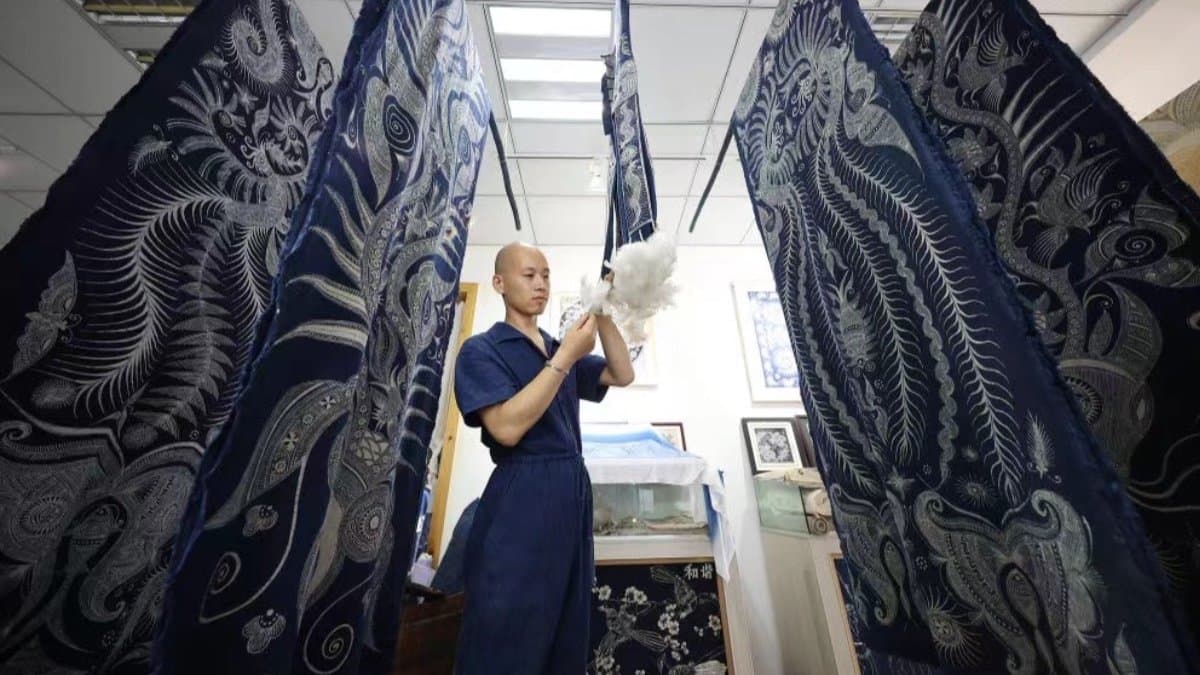
The batik workshop experience includes making your own piece to take home. Allow about 2-3 hours. Wear clothes you don't mind getting indigo-stained — that dye does not come out.
Sanbao Dong Village: Drum Towers and Living Architecture
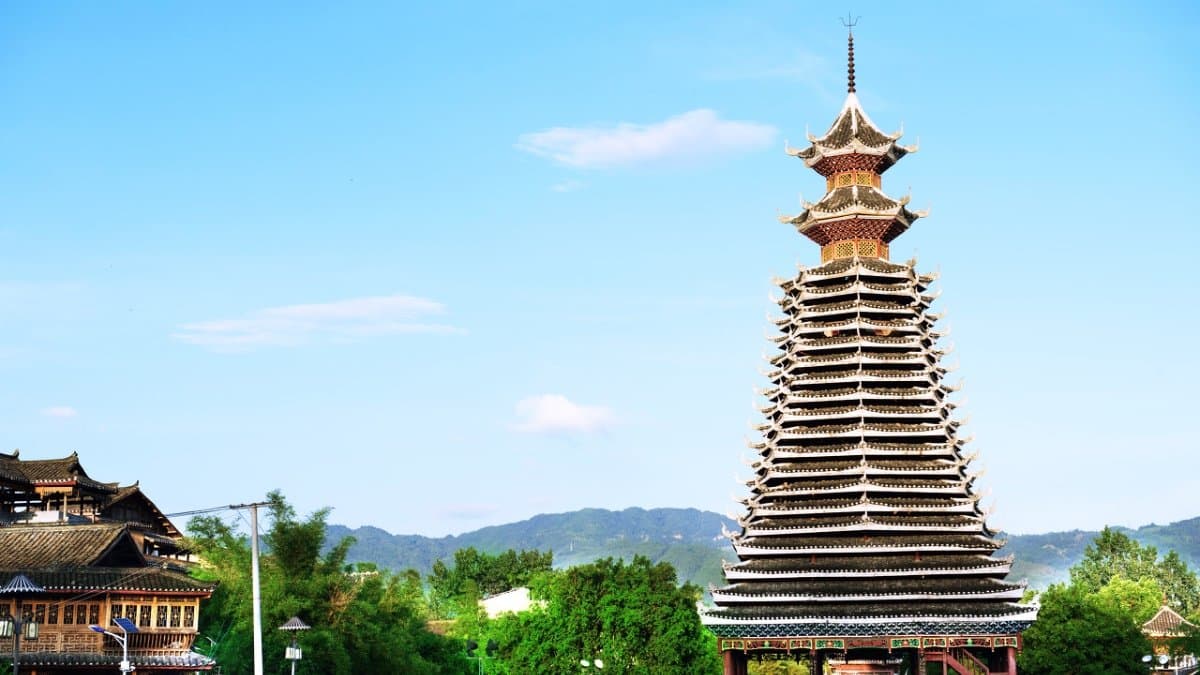
From Danzhai we drove another ninety minutes southeast to Rongjiang county, where Sanbao Dong village sits quietly along a river, billing itself — with some justification — as "the finest Dong village under heaven." The Dong are one of Guizhou's most distinctive ethnic groups, and their architecture alone is worth the detour. The centrepiece of every Dong settlement is the gulou (鼓楼), or drum tower — a multi-tiered wooden pagoda built entirely without nails, using a complex system of mortise and tenon joints. Sanbao's drum tower rises from the village centre like a wooden wedding cake, each tier slightly smaller than the one below, topped with curved eaves and a finial that points skyward. It's beautiful, but it's not decorative. The drum tower is the social nucleus of Dong life: a meeting hall, a courtroom, a concert venue, a shelter. When something important happens, someone climbs up and beats the drum, and the whole village comes. The Dong also build "wind-and-rain bridges" — covered wooden bridges that span the rivers running through their villages. These are gorgeous structures, with carved dragons and painted beams, and they serve a practical purpose beyond crossing water: in a province where it rains more than 200 days a year, they're communal shelters where people sit, chat, and wait out the downpours. We wandered Sanbao for a couple of hours, poking into the narrow lanes between wooden houses, watching kids chase chickens, nodding to grandmothers shelling beans on their doorsteps. Nobody tried to sell us anything. Nobody performed for us. It was just a village, going about its Wednesday.
Day 3: Basha — China's Last Gunman Tribe
If Sanbao was gentle, Basha was something else entirely. This is the village that travel articles love to call "China's last gunman tribe," and for once the sensational headline is actually accurate. Basha Miao village clings to a mountain ridge in Congjiang county, about two hours' drive from Rongjiang. The men here wear distinctive indigo-dyed tunics with no collars, carry handmade flintlock rifles on their shoulders, and sport a hairstyle called hugun (户棍) — the head is shaved except for a topknot, which is tied with a cotton band. It's a look that hasn't changed in centuries. They are, as far as anyone knows, the only community in China still legally permitted to carry firearms, a special dispensation granted because the guns are considered cultural heritage rather than weapons. The village is made up of five sub-villages clustered along the ridge, connected by stone paths that wind between dark timber houses. The air smelled of woodsmoke and wet earth. Roosters crowed. Dogs slept in doorways. It felt remote in a way that had nothing to do with distance — Basha is only 7 kilometres from the nearest town — and everything to do with time. The highlight was visiting the home of the village elder, known locally as the "Miao king" or zhailao (寨老). He's an elderly man with a weathered face and an extraordinary presence — quiet, dignified, with eyes that have clearly seen a lot. Through our guide translating, he told us about growing up in the mountains when the roads were still dirt tracks, about the significance of trees in Basha culture (they practise tree burial — when someone is born, a tree is planted; when they die, they're buried beneath it, and no grave marker is set), and about the tension between preserving tradition and the pull of the modern world. His grandson, he said, works in Guangzhou. Outside, some of the younger men demonstrated the sickle-blade shaving technique — using an actual farming sickle to shave each other's heads. It looked terrifying. They did it casually, the way you'd trim a hedge. I declined the offer of a demonstration on my own head, to general amusement.
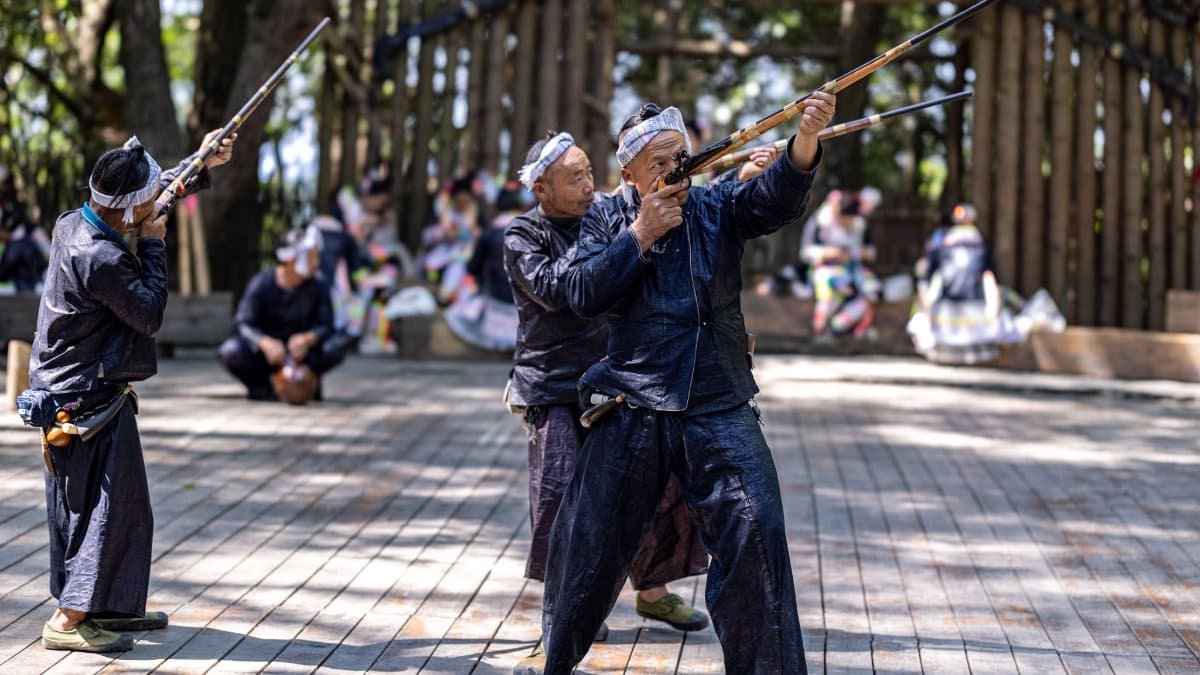
Basha charges a ¥60 entry fee that includes a cultural performance by local villagers. If you want the deeper experience — visiting the elder's home, understanding the tree burial tradition — you'll need a guide who has a relationship with the community. Don't just rock up and start photographing people without asking.
Day 4: Xiaoqikong — The Green Jewel on Earth's Belt
After Basha, we drove three hours southeast to Libo county, checking into a hotel along the Zhangjiang River. The next morning, we were up early and at the gates of Xiaoqikong Scenic Area (小七孔景区) by 8am — and good thing too, because this place gets absolutely mobbed by midday. Xiaoqikong translates as "Little Seven Holes," named after a Qing Dynasty stone bridge with seven arches that spans the Xiangshui River at the entrance. The bridge itself is a beauty — ancient moss-covered stone draped in vines, looking like something pulled from a Studio Ghibli film. But the bridge is just the appetiser. The scenic area stretches for several kilometres along a river valley, and the water here is something I genuinely struggled to process. It's not blue. It's not green. It's this luminous, shifting emerald-turquoise that changes shade depending on the depth, the light, and apparently its own mood. At Wolong Pool (卧龙潭), the water was so impossibly blue-green and so perfectly still that it looked artificial — like someone had filled a natural basin with antifreeze. The arc-shaped weir at its edge creates a curtain of water that falls in silky sheets into the pool below, catching the light in ways that made everyone around me go silent for a moment. Further upstream, the 68-level cascading waterfalls were a different mood entirely — riotous, noisy, joyful. Water tumbles over limestone ledges in a continuous chain of small falls and rapids, each one feeding into pools and channels that wind through a water forest where trees grow directly from the riverbed, their roots submerged year-round. Walking the boardwalk through this section, you're surrounded by the sound of rushing water on every side, mist on your face, the smell of wet stone and green things growing. It's sensory overload in the best possible way. The ancient seven-arch bridge at the far end was where I finally sat down and just stared. Covered in centuries of moss and hung with creeping vines, it arcs gracefully over water so clear you can count the pebbles on the riverbed four metres down. A bamboo grove frames it on one side. If you could bottle the feeling of standing on that bridge in the late morning light, you'd never need a holiday again.
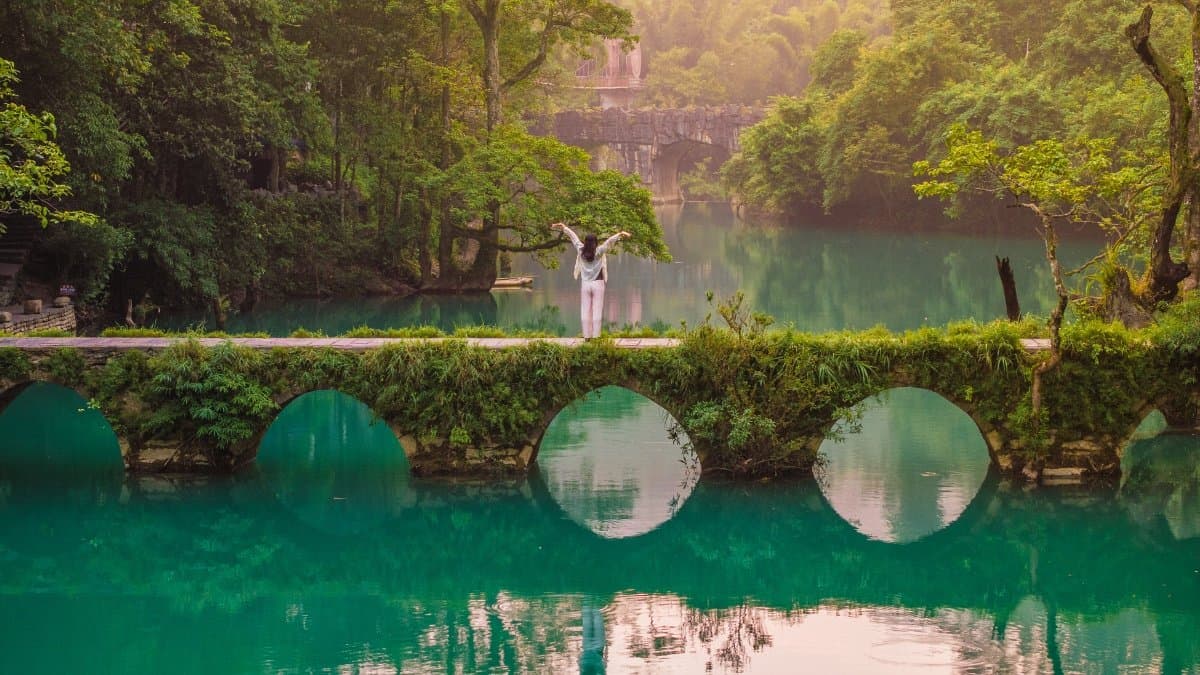
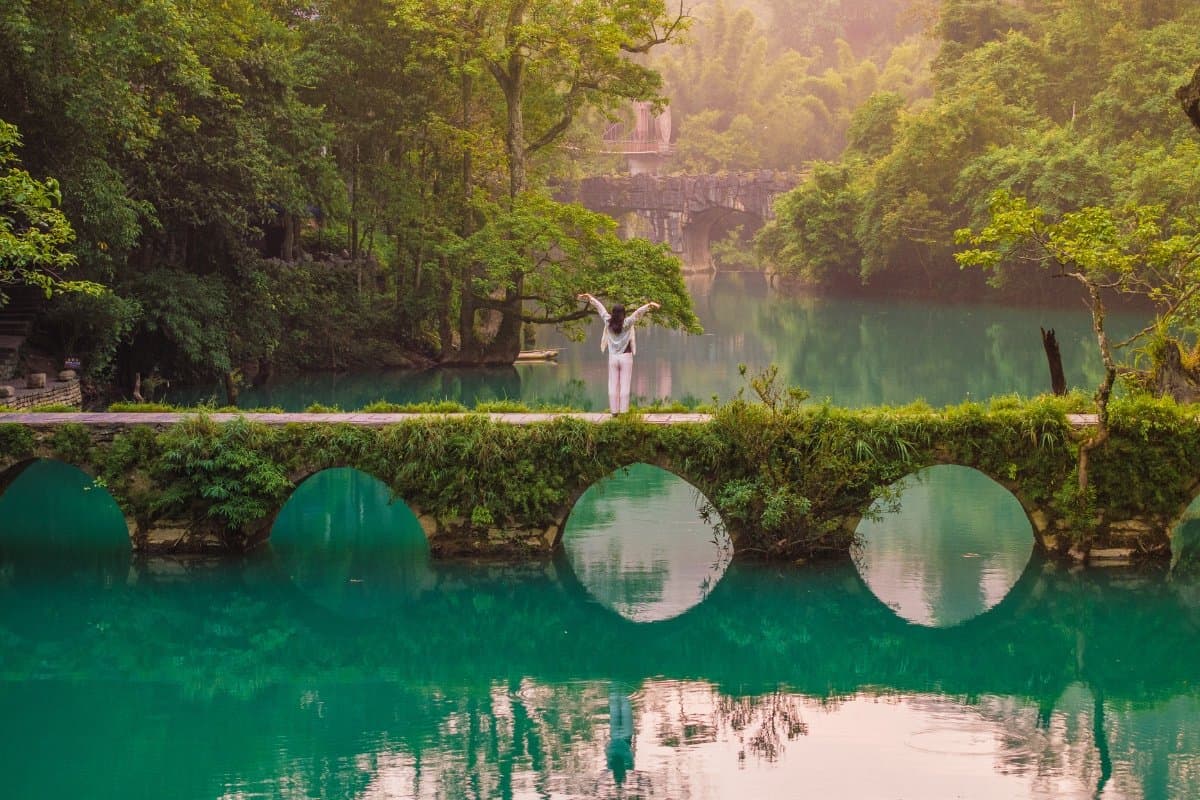
Xiaoqikong tickets are ¥130 and include the scenic shuttle bus. Buy online at least a day in advance — they cap daily visitors. The scenic area can close without warning during heavy rain or flood season. Wear shoes you don't mind getting wet; you'll want to wade into some of those pools.
Find hotels near Libo and Xiaoqikong scenic area.
Prices compared via Trip.com. We may earn a commission at no extra cost to you.
Compare HotelsDay 5: Da-Xiao Jing — Bamboo Rafting Through a Karst Dreamscape
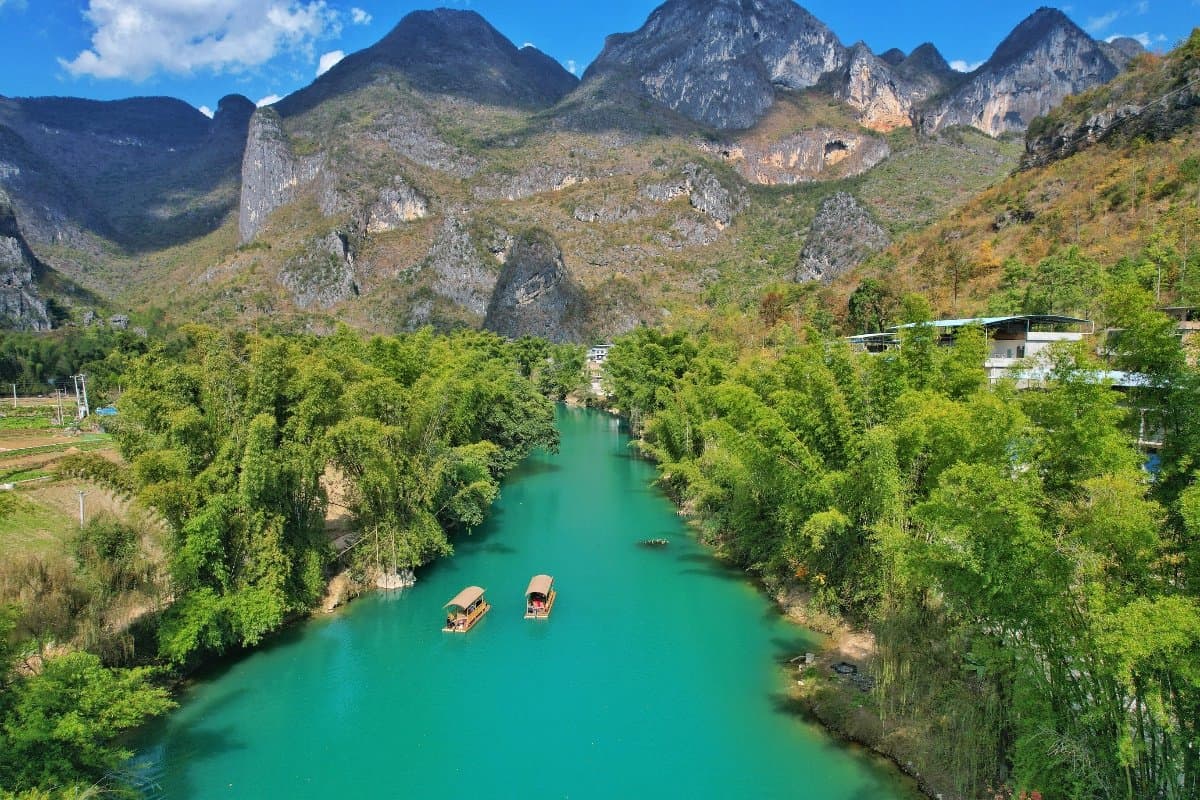
If Xiaoqikong was about water you look at, Da-Xiao Jing (大小井) was about water you float on. We drove an hour and a half from Pingtang county to a pair of small Buyi minority villages — Da Jing and Xiao Jing — where two underground springs surge up from the earth, merge into a single jade-green river, and flow between towering karst cliffs before eventually joining the Hongshuihe River. We boarded a bamboo raft at the village edge — a proper flat-bottomed raft, not a tourist pontoon — and the boatman poled us slowly downstream. The silence was immediate and total. No engine noise, no road sounds, just the drip of the pole and the occasional plop of a fish breaking the surface. The water beneath us was so clear that we could see the riverbed in perfect detail — smooth stones, waving aquatic grasses, the shadow of our raft gliding over it all like a slow-moving cloud. The banks were lined with enormous old banyan trees, their aerial roots hanging like curtains into the water. And then the cliffs closed in, and we entered the real spectacle: natural stone bridges — tianshenqiao (天生桥) — formed where the river had carved through the base of karst massifs, leaving massive arches of rock spanning overhead. Drifting beneath one of these, looking up at millions of tonnes of limestone suspended above you, dripping with ferns and small trees growing from the cracks — it triggers something primal. A mix of awe and mild disbelief that this place exists and almost nobody knows about it. We floated for about an hour, passing through two natural bridges and a semi-enclosed cave section where the light went from green to gold to a deep, shadowed teal. The boatman barely spoke the whole time. He didn't need to. The river was doing all the talking. After the raft, we drove four hours west to Xingyi, the capital of Guizhou's Qianxinan prefecture. It's a long drive, but the scenery en route — terraced rice paddies climbing steep hillsides, Buyi villages nestled in valleys, the road winding through ever-more-dramatic karst formations — made the time disappear.
Day 6: Wanfenglin — Cycling Through Ten Thousand Peaks
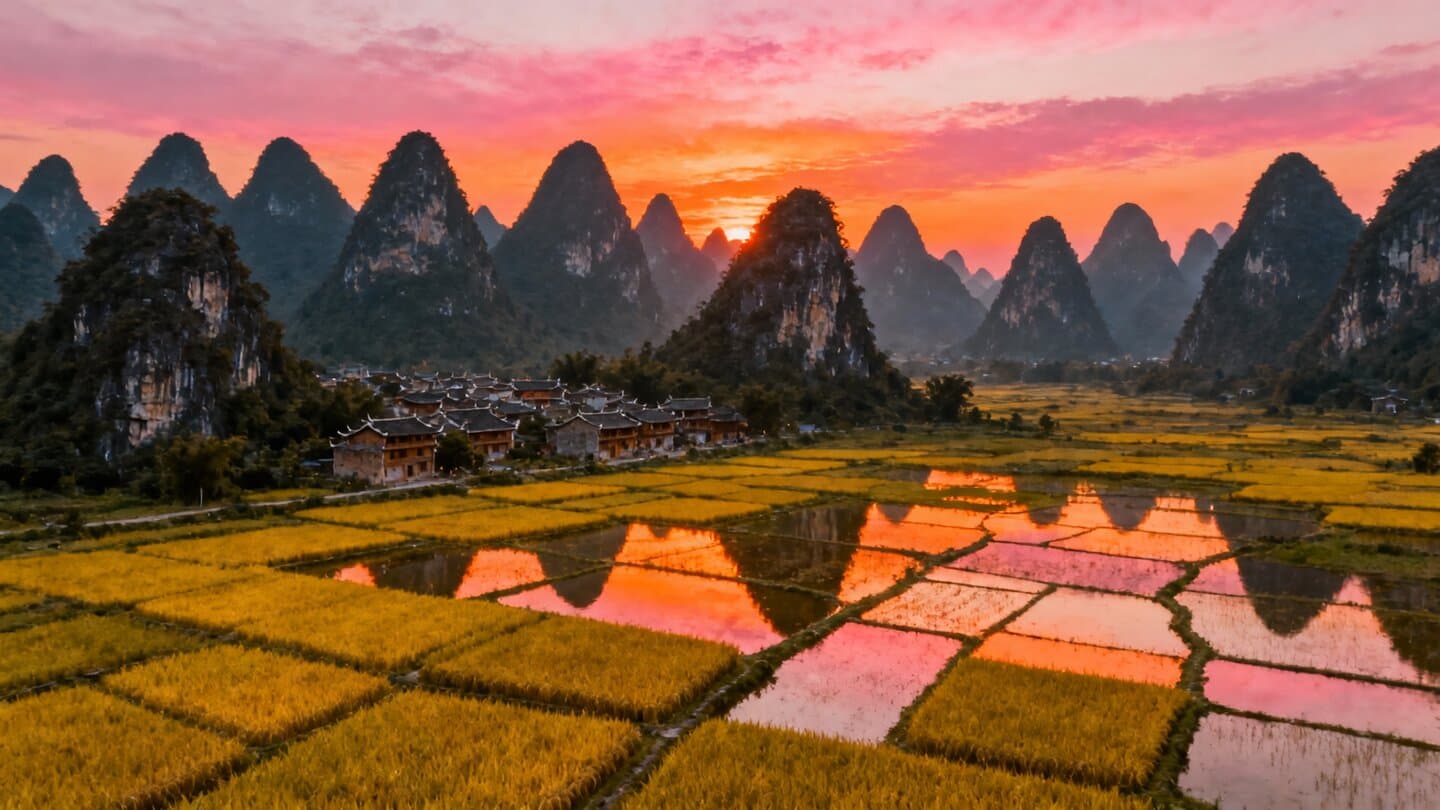
The Ming Dynasty explorer Xu Xiake came through this area in 1638 and wrote: "Of all the peaks under heaven, how numerous they are — only here do they form a forest." Four hundred years later, standing at the viewpoint above Wanfenglin (万峰林), I understood exactly what he meant. Wanfenglin translates literally as "Ten Thousand Peaks Forest," and the name is not hyperbole. From the elevated viewpoint, karst limestone cones march to the horizon in every direction — thousands of them, densely packed, their forms softened by green vegetation, rising from a patchwork floor of rice paddies, small rivers, and Buyi villages. The scale is staggering. It looks like a landscape from another planet, or like someone took the background from a Chinese ink painting and made it three-dimensional and real. But the best way to experience Wanfenglin isn't from above. It's at ground level, on a bicycle. We picked up bikes near the scenic area entrance and set off on a roughly ten-kilometre loop that winds through the valleys between the peaks. The riding is easy — flat to gently rolling, on smooth paved paths — and the scenery is relentless. Karst pinnacles tower on either side of you, some conical, some blade-sharp, some rounded and soft. Between them, rice paddies in various shades of green stretch to the base of the next peak. Small streams cross under stone bridges. The occasional water buffalo stands in a flooded field, regarding you with monumental indifference. We stopped constantly — not because we were tired, but because every hundred metres brought a new composition of peaks, paddies, and light that demanded attention. At one point, the path curved around the base of a particularly dramatic peak and opened onto a view of the entire valley, with the river Wanfeng winding through it like a silver ribbon. I stopped pedalling and just coasted, the wind in my face, the silence broken only by birdsong and the distant sound of someone's radio. In the afternoon, we visited a private courtyard tucked among the peaks — a small compound run by a "Wanfenglin drifter," a man from eastern China who'd fallen in love with the landscape and built a tiny art space and tea garden here. We sat in his courtyard, drinking local green tea, looking at the peaks framed by the doorway like a living scroll painting. He told us about the Buyi people who've lived in these valleys for centuries, and about the delicate balance between tourism and preservation. "The peaks will outlast all of us," he said. "The question is whether we deserve to keep looking at them."
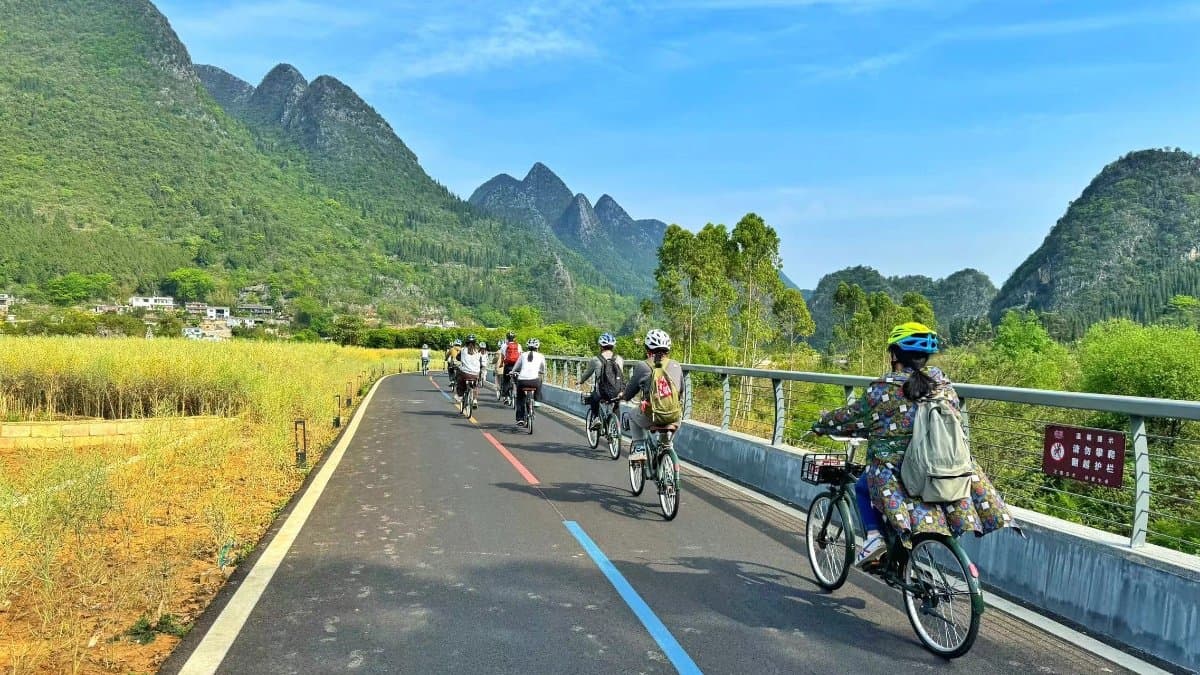
The cycling route is about 10km and flat — suitable for anyone who can ride a bike. Rental bikes are available at the scenic area. If the route is crowded during holidays, the tour may switch to scenic shuttle buses instead. Bring sun protection — there's not much shade on the valley floor.
Search for hotels in Xingyi near Wanfenglin scenic area.
Prices compared via Trip.com. We may earn a commission at no extra cost to you.
Compare HotelsDay 7: The Canyon Road and the Thundering Falls
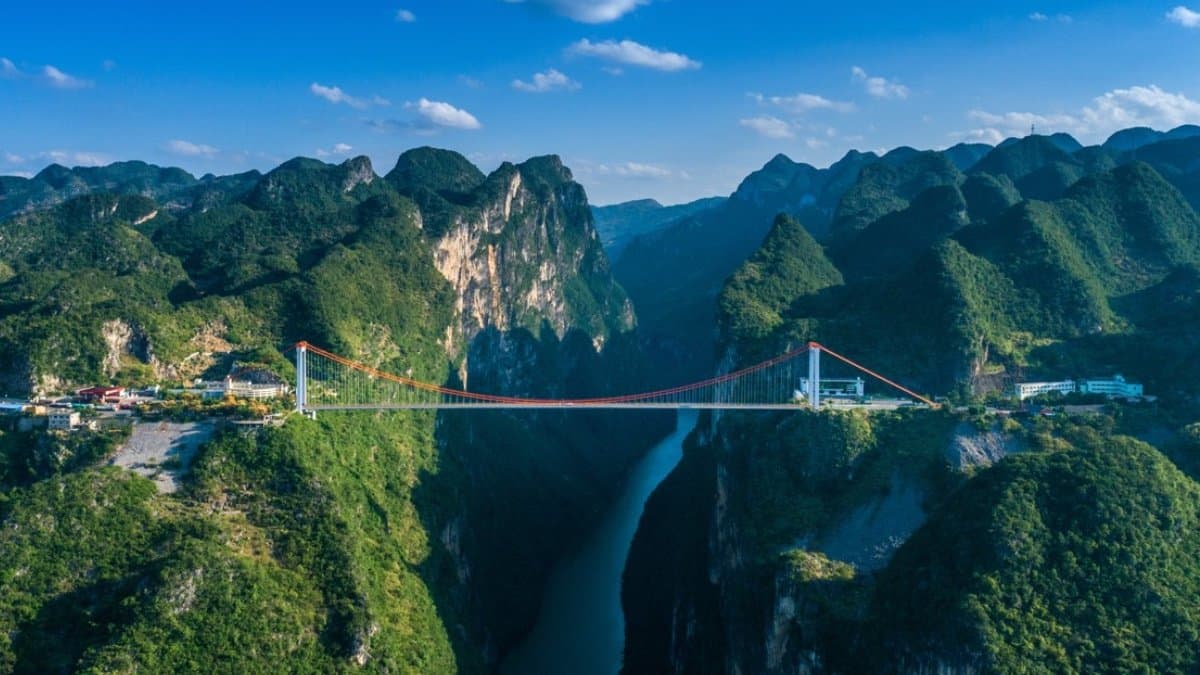
Day 7 was the grand finale, and it delivered on both fronts: one of the most scenic drives I've ever experienced, followed by Asia's most famous waterfall. Instead of taking the modern expressway from Xingyi to Huangguoshu, our guide chose the Guanxing Highway (关兴公路) — a two-lane road that winds along the rim of the Beipanjiang Canyon for roughly 220 kilometres. This was a calculated decision, and a brilliant one. The expressway would have been faster. The Guanxing Highway was unforgettable. The road clings to the mountainside above the canyon, and the views are continuous and jaw-dropping. Below, the Beipanjiang River — Guizhou's deepest gorge — snakes through a chasm of green-draped limestone walls, hundreds of metres deep. The scale is difficult to process from a moving vehicle. We stopped at a bridge that spans the canyon, and standing on it, looking down at the thread of silver river far below and the sheer walls rising on both sides, I felt genuinely small in a way that doesn't happen often. Our guide explained that bridges are everything in Guizhou. "Eight mountains, one river, one field" is how locals describe the terrain — the province is roughly 90% mountainous, and for centuries, communities separated by a single gorge might as well have been on different continents. The modern bridge-building campaign has been transformational: Guizhou now has more high bridges than any other province in China, including some of the highest in the world. On a clear day from the Guanxing Highway bridge, you can apparently see the Huajiang Grand Canyon Bridge in the distance — currently the world's highest, at 625 metres above the river. We squinted. We might have seen it. We definitely saw a lot of canyon.
Huangguoshu: The Sound Before the Sight
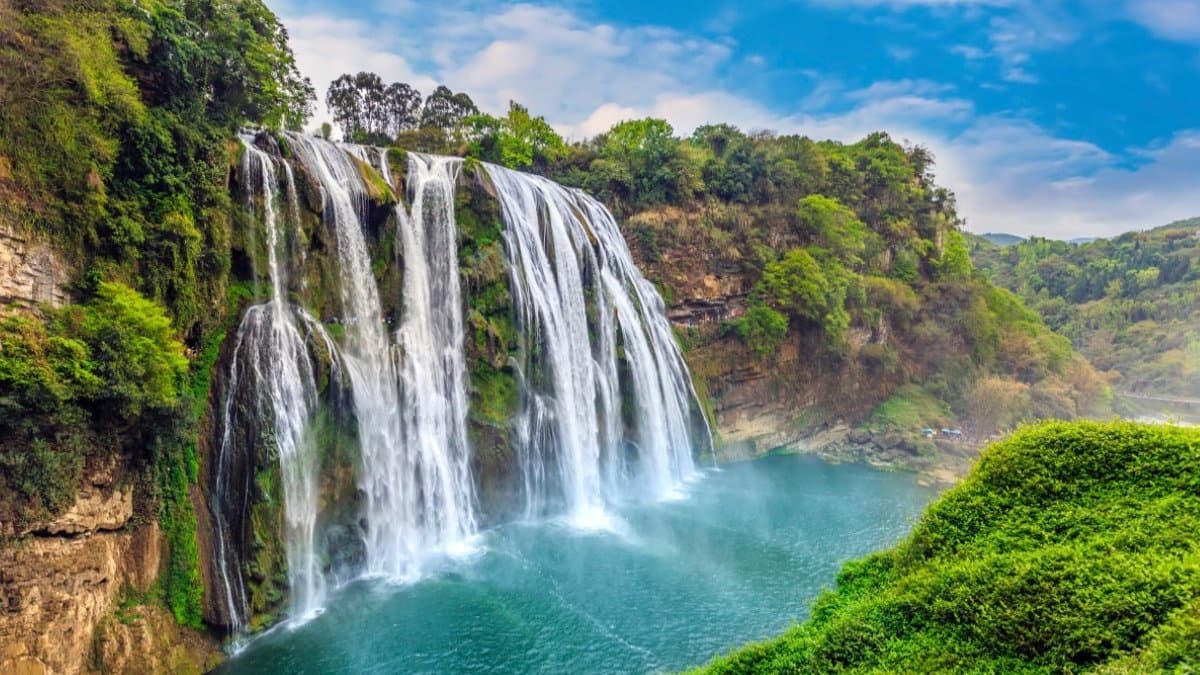
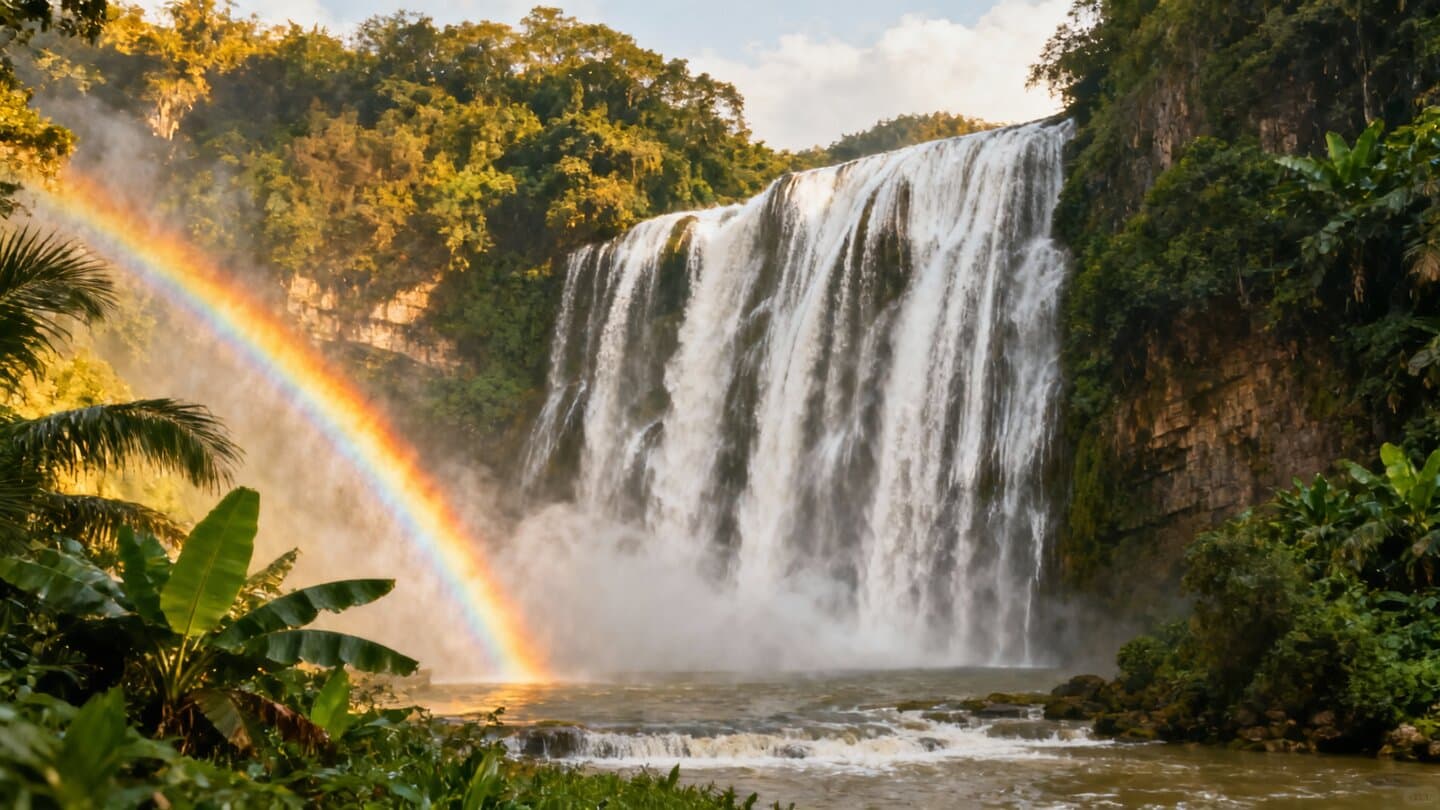
You hear Huangguoshu Waterfall (黄果树瀑布) before you see it. A low, continuous roar that builds as you walk down the forest path from the shuttle bus drop-off, getting louder with each step until the trees part and — there it is. Seventy-seven metres high and 101 metres wide, a continuous curtain of white water crashing into the Rhinoceros Pool below with a force that sends plumes of mist billowing fifty metres into the air. The mist catches the afternoon sun and throws out rainbows — not one, but sometimes two or three, stacked and shifting. Photos do not prepare you. Videos do not prepare you. The sheer volume of water, the noise, the physical sensation of mist hitting your skin from twenty metres away — it's an assault on the senses in the best possible way. I stood on the viewing platform with water streaming down my face and my camera lens completely fogged, grinning like an idiot. Huangguoshu is one of the few major waterfalls in the world where you can walk behind the curtain of water — there's a cave system called Shuiliandong (水帘洞, literally "Water Curtain Cave," yes, from Journey to the West) that runs behind the falls. We didn't do this on our trip — the queues can be monstrous — but knowing it exists adds another layer to the experience. We also visited Doupotang Waterfall (陡坡塘瀑布), a wider, shorter falls upstream that's famous for being the filming location of the 1986 Journey to the West TV series. It's beautiful in a more gentle way — broad and curved, with a peaceful pool below — and far less crowded than the main event. After the falls, we drove two hours back to Guiyang, arriving in time for a farewell dinner of sour soup fish — coming full circle.
Huangguoshu tickets are ¥160 including scenic shuttle bus. The full scenic area includes three separate waterfall areas, but the main falls and Doupotang are the essential two — skip Tianxingqiao unless you have all day and enjoy crowds. Bring a waterproof phone case or a ziplock bag. You will get soaked near the main falls.
Day 8: Guiyang Departure — What to Do With a Free Morning
The final day had no scheduled activities, just checkout and flights. If you've got time before departing, Guiyang has several worthwhile options. Qianling Mountain Park (黔灵山公园) is a forested city park where wild macaques are alarmingly confident and will absolutely steal your snacks — entertaining, as long as you don't carry a plastic bag. The Guizhou Provincial Museum (贵州省博物馆) is free and excellent, with standout galleries on ethnic minority cultures and paleontology. Or just wander Taiping Street, a revitalised neighbourhood with coffee shops, street food, and the occasional vendor selling fold-eared-root milkshakes (zhe'ergen, 折耳根 — it tastes exactly as alarming as it sounds, but locals swear by it). I left Guiyang feeling something I don't always feel after a group tour: that I'd been somewhere genuinely new. Not new as in "I haven't been here before," but new as in "I didn't know places like this still existed." Guizhou doesn't feel like the China you see on TV or in travel magazines. It feels older, wilder, more culturally textured, and more visually dramatic than anywhere I'd expected to find in a country I thought I already knew reasonably well. I want to go back. I want to sit in that batik workshop again and watch the painting ladies draw stars. I want to float through another natural stone bridge. I want to stand in the mist of Huangguoshu with water on my face and rainbows overhead. Guizhou does that to you. It gets under your skin like indigo dye — slowly, permanently, beautifully.
Practical Information: What You Need to Know
Getting There
Guiyang Longdongbao International Airport (KWE) has direct flights from most major Chinese cities and a growing number of international connections. From Chengdu, Kunming, or Guangzhou, flights are about an hour. The high-speed rail station (Guiyangbei) connects to Chengdu (3.5h), Kunming (2h), Changsha (3h), and Guangzhou (5h). Book flights early for the best prices — budget carriers regularly offer one-way fares under ¥500.
Cost Breakdown
The 8-day guided tour costs ¥4,380 per person (roughly $600/£480), which covers all transport within the itinerary, seven nights' accommodation (3-4 star hotels), selected meals, all entrance tickets, the batik workshop, bamboo raft, cycling, and a bilingual guide. Not included: flights to/from Guiyang, most dinners (budget ¥60-80/day for meals on your own — eating in Guizhou is wonderfully cheap), and personal expenses. Total all-in budget for the 8 days including flights from a major Chinese city: roughly ¥5,500-6,000 ($750-820).
Best Time to Visit
April through October is prime season. Summer (June-August) brings the most water to the falls and the greenest landscapes, but also the biggest crowds and occasional heavy rain that can close Xiaoqikong. April-May and September-October offer excellent weather, fewer tourists, and lower prices. Guizhou is refreshingly cool in summer — Guiyang's average July temperature is about 24°C — making it a popular escape from the furnace-like heat of eastern Chinese cities.
What to Pack
Rain gear is non-negotiable — Guizhou rains frequently and often without warning. Comfortable walking shoes with grip (you'll average 10,000+ steps daily on uneven village paths and scenic area trails). A waterproof phone case for Huangguoshu. Layers — mornings can be cool in the mountains, afternoons warm. Mosquito repellent for the village visits. Motion sickness medication if you're sensitive — some of the mountain roads are seriously winding.
Cultural Etiquette
Guizhou is home to 17 indigenous ethnic groups, many with distinct customs. Always ask before photographing people. In Basha, photography is included in the entry ticket for public areas, but ask permission before entering anyone's home. If offered rice wine (and you will be offered rice wine), at least accept a sip — declining outright can be considered rude. In Dong villages, the drum tower is a sacred communal space; enter respectfully. Guizhou's ethnic communities are welcoming, but they're not tourist attractions — treat them as you would any host inviting you into their culture.
This tour is designed for ages 20-45 with a maximum of 20 people per group. If you're travelling independently, you can visit most of these destinations by combining local buses and ride-sharing apps, but the logistics are considerably more complex — Guizhou's rural destinations are spread across large distances with limited public transport.
Browse activities and tours in Guizhou — waterfalls, villages, and karst landscapes.
Prices compared via ChinaCheapo. We may earn a commission at no extra cost to you.
Browse Activities