Why Southeast Shanxi Changed Everything I Thought I Knew About China
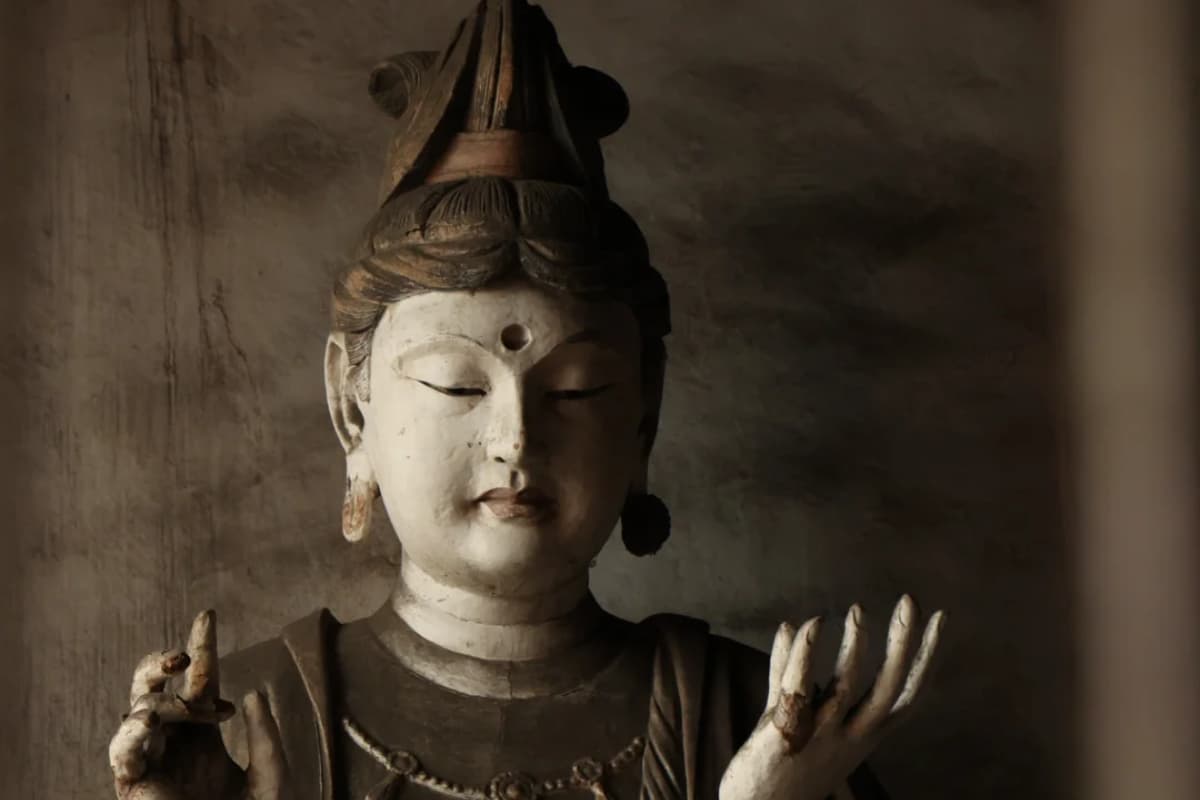
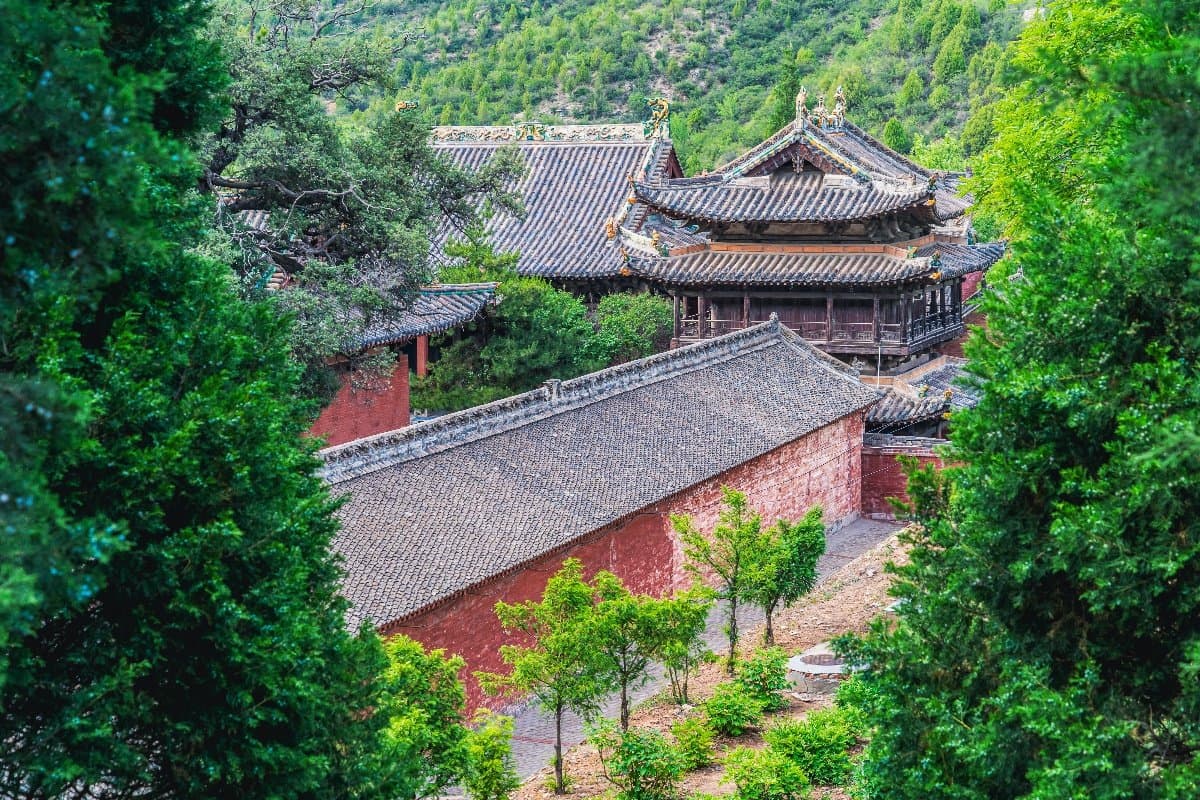
I'll be honest: before this trip, I thought I understood Chinese temples. I'd done the greatest hits — Forbidden City, Temple of Heaven, the big Buddhist complexes in Xi'an. Impressive, sure. But Southeast Shanxi is a different animal entirely. This is where China keeps its real treasures, the ones too remote, too fragile, too genuinely sacred to turn into theme parks with gift shops and selfie spots. Southeast Shanxi — known as Jindongnan (晋东南) — sits in the crumpled folds of the South Taihang mountains, straddling the cities of Changzhi and Jincheng. On paper, it's an unremarkable corner of coal country. In reality, it contains 73% of all ancient buildings in Shanxi province, and Shanxi province contains more pre-Song dynasty wooden structures than the rest of China combined. Let that sink in. Nearly half of China's surviving ancient architecture is concentrated in this one stretch of mountain valleys and dusty villages that most Chinese people have never heard of. Then Black Myth Wukong happened. The blockbuster video game drew heavily from these temples for its visual design — the 28 Constellations of Yutang Temple, the Celestial Beings of Tiefo Temple, the serene Bodhisattvas of Faxing Temple all made it into the game's extraordinary art direction. Suddenly, places that architecture nerds had been quietly pilgrimaging to for decades were trending on social media. And honestly? That's a good thing. These buildings deserve to be seen. I joined a five-day guided tour that starts and ends in Zhengzhou, covering eight national-treasure-level ancient buildings with a professional architectural historian providing lectures at every stop. What I found was something I wasn't expecting: not just old buildings, but living faith. Temples where villagers still burn incense and pray, where guardian families have protected wooden structures through wars and revolutions for generations, where the dust on the floor has been swept by the same family for fifty years. This isn't a museum experience. It's a time machine.
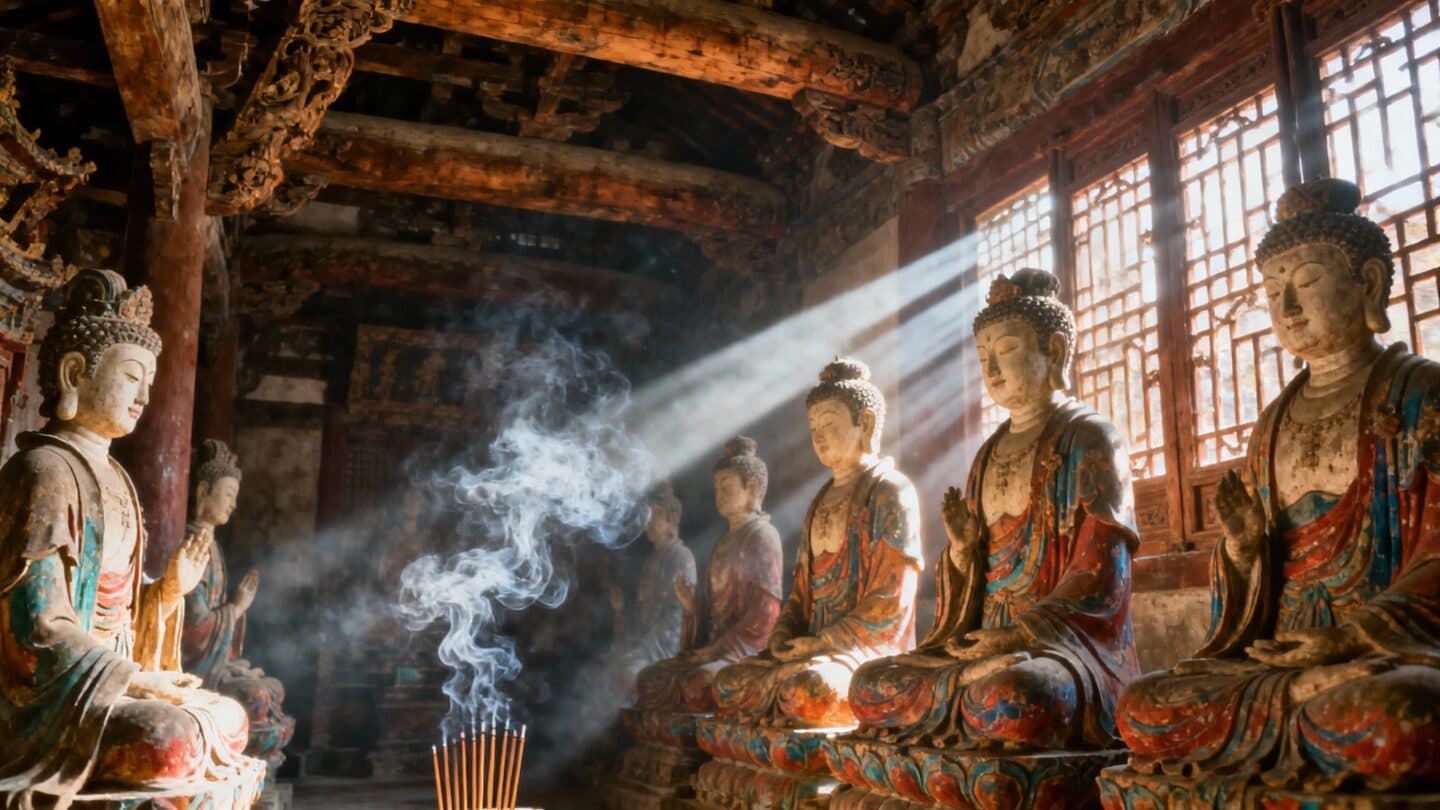
This route covers the Changzhi and Jincheng areas of Shanxi province, which are genuinely remote. Public transport exists but is slow and irregular. A guided tour with a knowledgeable architectural expert is strongly recommended — many of these temples require advance permission to visit, and without expert commentary, you'll miss 90% of what makes them extraordinary.
Day 2: Yutang Temple — 28 Constellations That Exist Nowhere Else on Earth
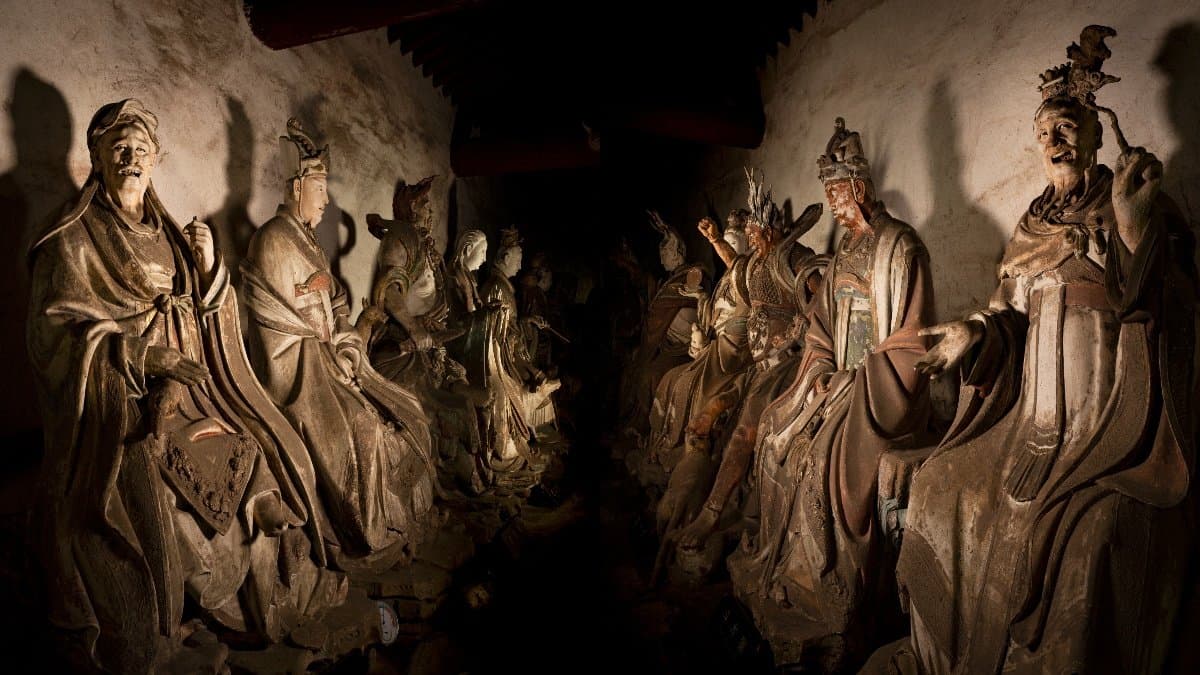
The trip begins in earnest on day two, after gathering in Zhengzhou the night before. It's a two-hour drive from the hotel to Jincheng, and the landscape shifts fast — flat Henan farmland gives way to the first muscular ridges of the Taihang range, and suddenly you're climbing through tight valleys with villages wedged into every usable pocket of flat ground. Fucheng Yutang Temple (府城玉皇庙) is in a village that looks, from the outside, like every other small Shanxi settlement: low brick buildings, a couple of elderly men sitting on stools by the road, a general atmosphere of unhurried permanence. Then you walk through the temple gate and the world changes. The main hall houses the 28 Constellations (二十八星宿) — a set of Yuan dynasty sculptures that fuse Chinese astronomy, Daoist cosmology, and Tang dynasty animal symbolism into 28 human-scale figures that are, without exaggeration, unlike anything else I've ever seen. Each figure represents one of the 28 star mansions used in Chinese celestial navigation, combined with one of 21 animals and the seven celestial bodies (Sun, Moon, and five planets). So you get figures like "Void Sun Rat" (虚日鼠), "Room Sun Rabbit" (房日兔), and "Chariot Water Earthworm" (轸水蚓) — names that sound absurd until you see the sculptures, which are anything but. These are not serene Buddhas sitting in peaceful contemplation. They're dynamic, expressive, individual. Some are fierce warriors mid-stride, others are scholars caught in thought, others look like they might actually speak to you. The sculpting quality is extraordinary — the fabric folds alone would make a Renaissance master nod appreciatively. Our architectural historian spent a full hour in this hall, and it wasn't enough. I could have stayed all day. The kicker? This is the only complete set of 28 Constellations sculptures surviving anywhere in the world. The only one. If this hall collapsed tomorrow, this art form would be gone from human history. When you stand in front of them knowing that, the air in the room feels different.
Tiefo Temple: 24 Celestial Beings Behind a Door That Was Closed for Years
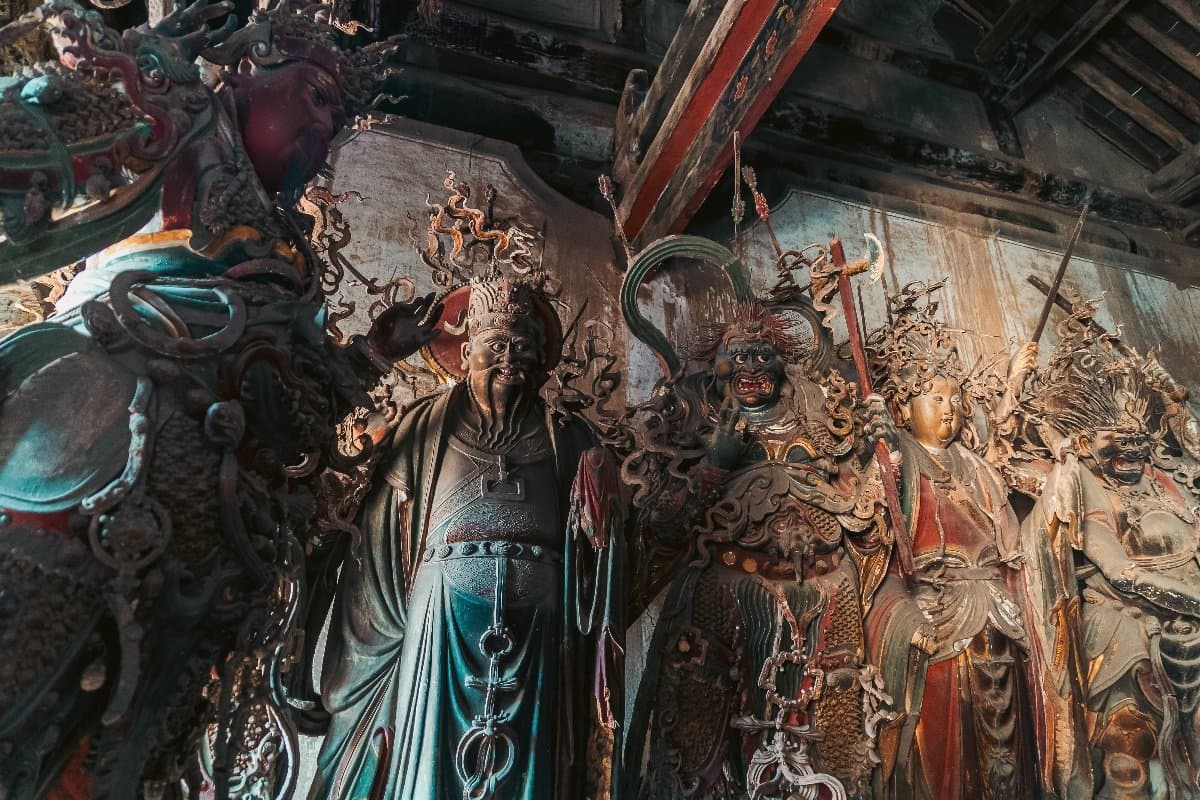
Forty minutes down the road from Yutang, Tiefo Temple (铁佛寺) in Gaoping has a reputation among architecture enthusiasts as one of the great frustrations — a temple with extraordinary sculptures that was closed to visitors for years. Access has recently reopened, and the timing couldn't be better: Black Myth Wukong players will recognise the Celestial Beings here as direct inspiration for the game's Huangmei boss arena. Tiefo Temple gets its name from an iron Buddha that was installed during the Jin dynasty's Dading era (1167 CE). But the real draw is the hall of 24 Celestial Beings (二十四诸天) — painted sculptures of heavenly guardians arranged around a central Buddha platform. The craftsmanship is meticulous: individual strands of hair, flowing robes with visible brushstroke detail in the paint, facial expressions that shift depending on where you stand. Some are fierce protectors with bulging eyes and clenched fists. Others are serene, almost gentle, with lowered eyelids and the faintest suggestion of a smile. Our expert spent over an hour here, pointing out details I would never have noticed on my own: the way certain figures' feet are positioned to suggest movement, the symbolic objects they carry, the subtle hierarchy encoded in their heights and positions. The Shakyamuni lotus-throne pedestal at the centre, with its intricate coloured relief work, is the specific piece that Game Science used as reference for Black Myth Wukong's grabbing-the-hero-mid-air sequence. Standing in front of it, I pulled up the game screenshot on my phone. The match was uncanny. What struck me most was the silence. No crowds, no audio guides, no souvenir sellers. Just these ancient figures and us, in a room that smelled of incense and old wood and centuries of accumulated devotion.
Erxian Temple: China's Only Young Female Deities and a Jin Dynasty Vanity Tower
The afternoon's final stop is Xixi Erxian Temple (西溪二仙庙) in Lingchuan, and it's a curveball after the intensity of the morning's sculpture halls. Where Yutang and Tiefo are about overwhelming artistic achievement, Erxian is about something quieter and stranger: a local folk religion built around two young women who became goddesses. The Two Immortals (二仙) of Southeast Shanxi are unique in Chinese religious culture. They're young, they're female, and they're worshipped as a pair — all of which is genuinely unusual in a tradition dominated by male deities, elderly sages, and solo figures. The story involves filial piety, supernatural transformation, and the kind of local mythology that exists nowhere in the official canon but has sustained continuous worship in these valleys for over a thousand years. The temple's incense burners were warm when we arrived. Someone had been praying that morning. Architecturally, the prize here is the Jin dynasty "vanity tower" (梳妆楼) — a rare surviving example of a specific building type from the 12th century that was used as a symbolic dressing chamber for the deities. It's a delicate, elegant structure that looks almost impossibly refined for its age. The great Yuan dynasty poet Yuan Haowen visited this temple as a young man and wrote a poem about it: "Between one year, I come and return again / The green mountains unchanged, a painted screen unfurled." Standing in the same courtyard eight centuries later, the green mountains were still there, the painted screen still unfurled. The drive from Erxian Temple to the hotel in Lingchuan passes through mountain twilight, with the Taihang peaks silhouetted against a fading sky. The included dinner is local Shanxi fare — oat noodle rolls, steamed potatoes, stir-fried wild vegetables. Simple, warming, real. The kind of food that tastes better when you've spent the day having your mind expanded.
Find flights to Zhengzhou — the gateway city for Southeast Shanxi tours.
Prices compared via Trip.com. We may earn a commission at no extra cost to you.
Search FlightsDay 3: Wang Mang Ridge — Where the Central Plains Fall Off a Cliff
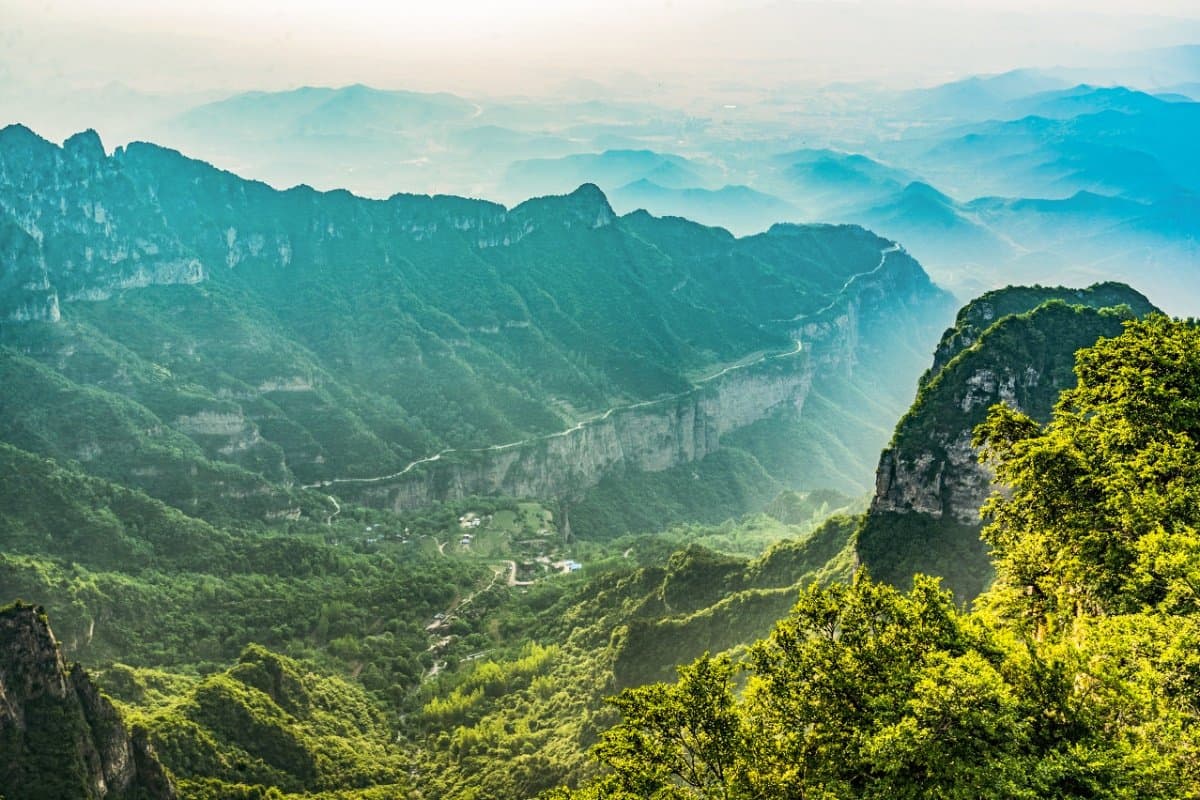
Day three opens with geology instead of theology, and honestly, after the sensory overload of day two's three temples, your brain needs the palate cleanser. Wang Mang Ridge (王莽岭) is the highest point of the South Taihang range, and it is — I'm not being dramatic here — one of the most spectacular viewpoints I've encountered anywhere in China. The South Taihang is the geological boundary where the Loess Plateau drops away to the North China Plain. It's not a gradual slope. It's a wall. Standing on Wang Mang Ridge, you look out over sheer cliffs that fall hundreds of metres to a haze-shrouded lowland stretching to the horizon. To the west, rugged mountain terrain. To the east, flatland as far as you can see. The boundary between two worlds, two climates, two civilisations — the pastoral highland and the agricultural plain — drawn in vertical rock. The ridge is named after Wang Mang, the controversial usurper who briefly overthrew the Han dynasty in 9 CE and supposedly chased the future Emperor Guangwu to these cliffs. Legend has it the emperor escaped across the mountains while Wang Mang's armies, unable to follow, could only stare at the impassable terrain. Standing up there in the morning wind, I believed it. This landscape doesn't compromise. There's a light hiking path along the ridge — nothing technical, maybe an hour of walking — that takes you past the best viewpoints. The morning light catches the cliff faces at angles that make photographers weep. Our group barely spoke for the first twenty minutes. Everyone was just staring.
Xiyagou Cliff-Hanging Road: 3 Generations, 30 Years, One Impossible Road
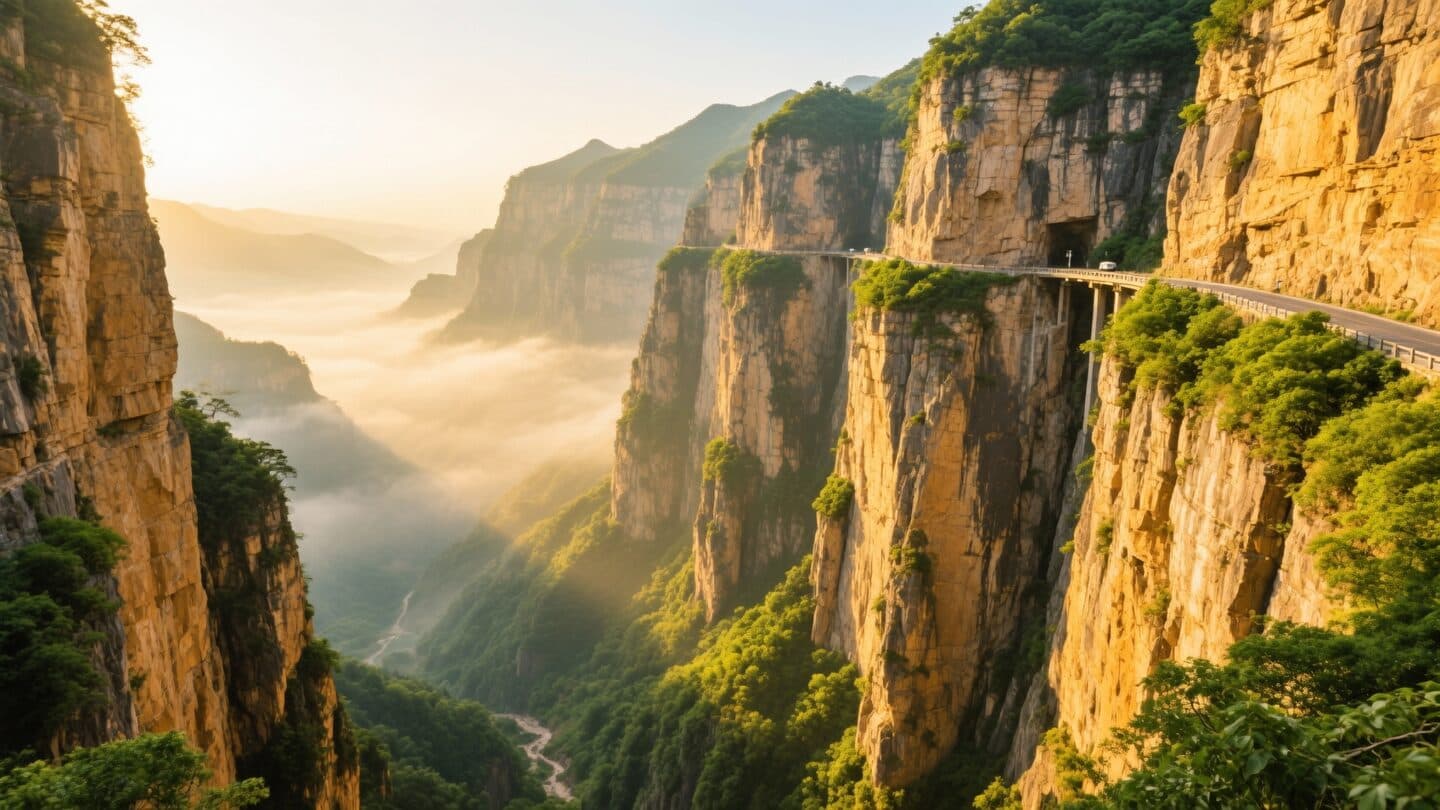
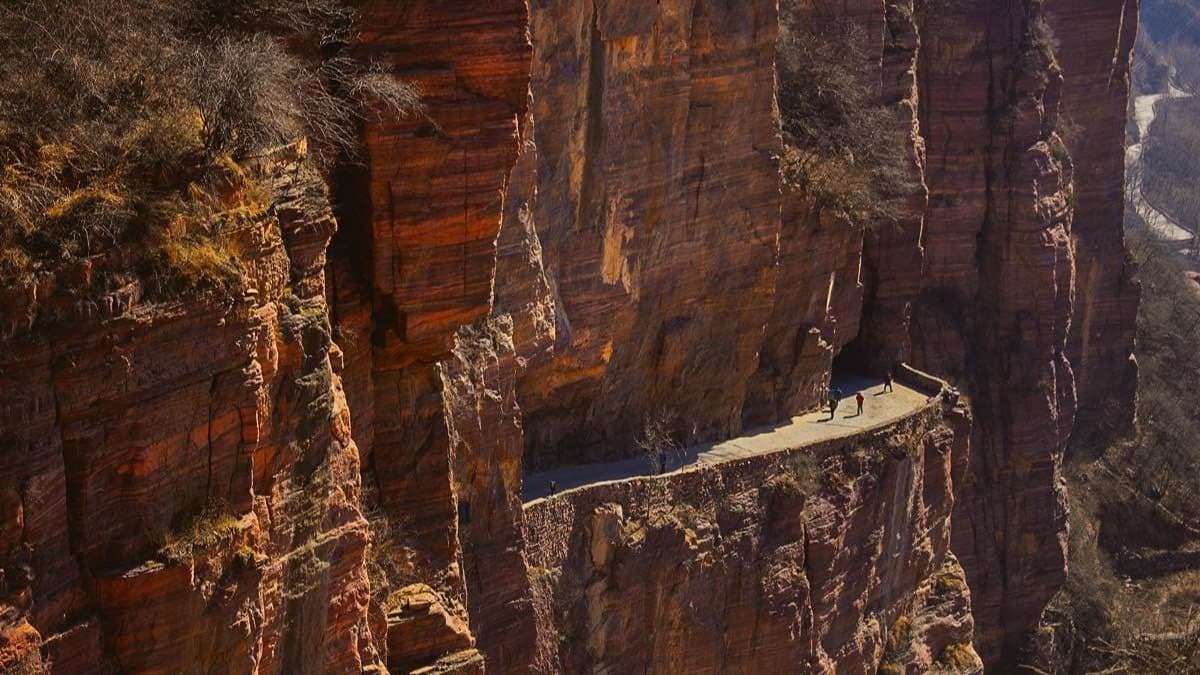
From Wang Mang Ridge, the bus descends through the Xiyagou cliff-hanging road (锡崖沟挂壁公路), and this is where the trip shifts from admiration to something closer to awe mixed with disbelief. Xiyagou village sits at the bottom of a box canyon — surrounded on all sides by vertical cliffs, with no natural road out. For centuries, the only way to reach the outside world was a narrow mountain path that took hours to traverse and was impassable in bad weather. In the 1960s, the villagers decided they'd had enough. They would build a road. Through the cliff. What followed was thirty years of hand-carved engineering. Three generations of villagers — grandparents, parents, and children — took turns chiselling a tunnel road through solid rock. No heavy machinery. No government funding at first. Just hammers, chisels, and the absolute refusal to remain isolated. The road is carved directly into the cliff face, with window-like openings cut through the rock at intervals for light and ventilation. Driving through it, the valley floor drops away outside these windows, and you realise you're suspended in the middle of a vertical cliff in a tunnel that was carved by human hands. I've driven cliff roads before — the Karakoram Highway, the Trollstigen in Norway — but there's something about knowing this one was built not by an engineering corps with dynamite and cranes, but by farmers with hand tools and generational stubbornness, that makes it hit completely differently. Our guide told us the village population was never more than a few hundred people. The road took thirty years. They just kept going. We stopped for lunch in Xiyagou village itself — local Shanxi noodles, the kind of carb-heavy mountain food that makes perfect sense when you're surrounded by terrain this demanding. The villagers were friendly, curious about our group, and clearly proud of their road. As they should be.
Faxing Temple: The Crown of Song Dynasty Sculpture
After lunch, it's a two-hour drive west to Changzhi, and the route passes through landscapes that alternate between industrial grit (this is coal country, after all) and startling natural beauty. Then you arrive at Faxing Temple (法兴寺), and the architecture nerds in the group start making involuntary noises. Faxing Temple is famous for three things, collectively known as its "Three Absolutes" (三绝): a Tang dynasty sarira pagoda, a Tang dynasty stone eternal lamp, and — the main event — the Song dynasty painted sculptures in the Yuanjue Hall. These twelve Enlightened Ones (十二圆觉) have been described by Chinese art historians as "the crown of Song dynasty sculpture" (宋塑之冠), and spending time with them, you understand why. They're life-size Bodhisattvas seated in a circle, each in a slightly different posture of contemplation. The craftsmanship is astonishing: the drape of their robes follows the contours of their bodies with a naturalism that feels almost modern, their facial expressions hover in that specific zone between serenity and compassion that Song dynasty sculptors somehow nailed better than anyone before or since. One figure has her head tilted very slightly to the left, as if listening to something only she can hear. Another has his hands positioned in a gesture so relaxed it makes you want to breathe more slowly. Our historian pointed out something I'd never have noticed: the way the sculptors handled the transition between painted surface and bare clay. In some spots, the original Song dynasty paint has worn away, revealing the raw sculpted surface beneath — and the detail is just as precise underneath. These artists weren't hiding imperfections under paint. They were perfectionists all the way down. Outside the hall, you look across the valley at a working coal mine and a row of truck-battered houses. The juxtaposition is jarring. Inside, timeless beauty. Outside, the grinding machinery of modern industry. It's very Southeast Shanxi — the sacred and the pragmatic, existing side by side without apology.
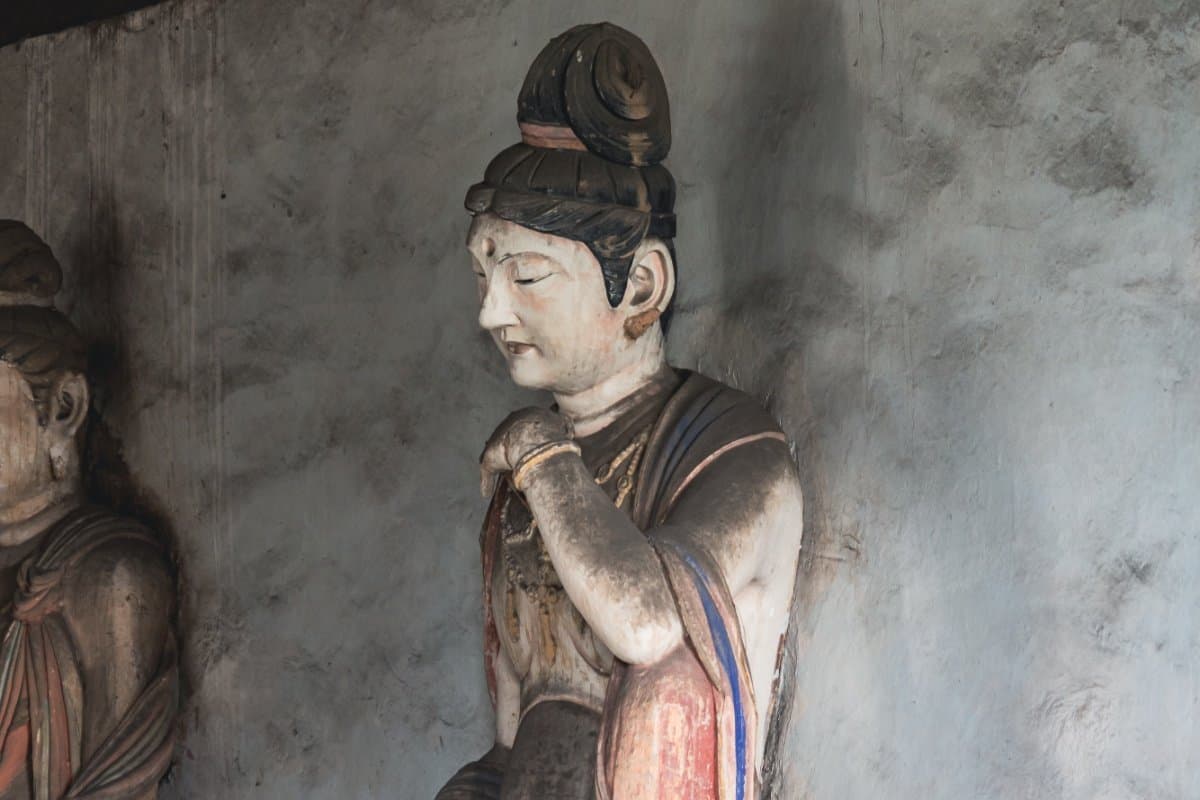
Photography is restricted or forbidden inside most of these temple halls to protect the centuries-old pigments from flash damage. Respect the rules — and honestly, put your phone away anyway. These sculptures deserve your full, undistracted attention.
Day 4: Dragon Gate Temple — Six Dynasties Under One Roof, and Tea with the Guardian
Day four takes you into the Zhuo Zhang River valley (浊漳河谷), a fifty-kilometre stretch of river gorge that contains eight national-treasure-level buildings — a concentration of ancient architecture that has no parallel anywhere in China. The valley has been a trade corridor for millennia, and the wealth that flowed through it funded temples, monasteries, and shrines at an extraordinary rate. First stop: Dragon Gate Temple (龙门寺), and this is where the trip's cumulative education pays off. By day four, you've learned enough from the expert lectures to start reading buildings yourself — identifying bracket sets, dating roof structures, spotting where one dynasty's additions meet another's. Dragon Gate Temple is the ultimate test, because it contains structures from six consecutive dynasties: Five Dynasties, Song, Jin, Yuan, Ming, and Qing. Walking through the compound is like walking through a textbook of Chinese architectural history, except the textbook is real and you can touch the wood. The Five Dynasties west side hall is the oldest surviving structure — its bracket sets are simpler, more robust, with a weight-bearing honesty that later dynasties would trade for decorative complexity. The Song hall next door is more refined, the Jin additions more experimental, the Yuan work heavier and more assertive. By the time you reach the Ming and Qing buildings at the back, you can feel the evolution in your bones. Architecture as living timeline. But the highlight of Dragon Gate Temple isn't the buildings themselves. It's the guardian. The temple's caretaker has been sweeping these courtyards, tending these altars, and watching over these ancient structures for decades. He set up small wooden stools in the east wing and served us tea — plain, hot, from a thermos — while he talked about his life as a temple guardian. His family has protected this site through periods when nobody cared about ancient architecture, when the buildings were crumbling and there was no money for repairs, when he was essentially a one-man preservation society funded by nothing but stubbornness and duty. "The buildings were here before me," he said, refilling my cup. "They'll be here after me. I just make sure nobody bothers them in between." If you're lucky, he'll unlock a side door and show you something not on the standard tour. I won't spoil what's behind it. Just be polite, drink your tea, and ask good questions.
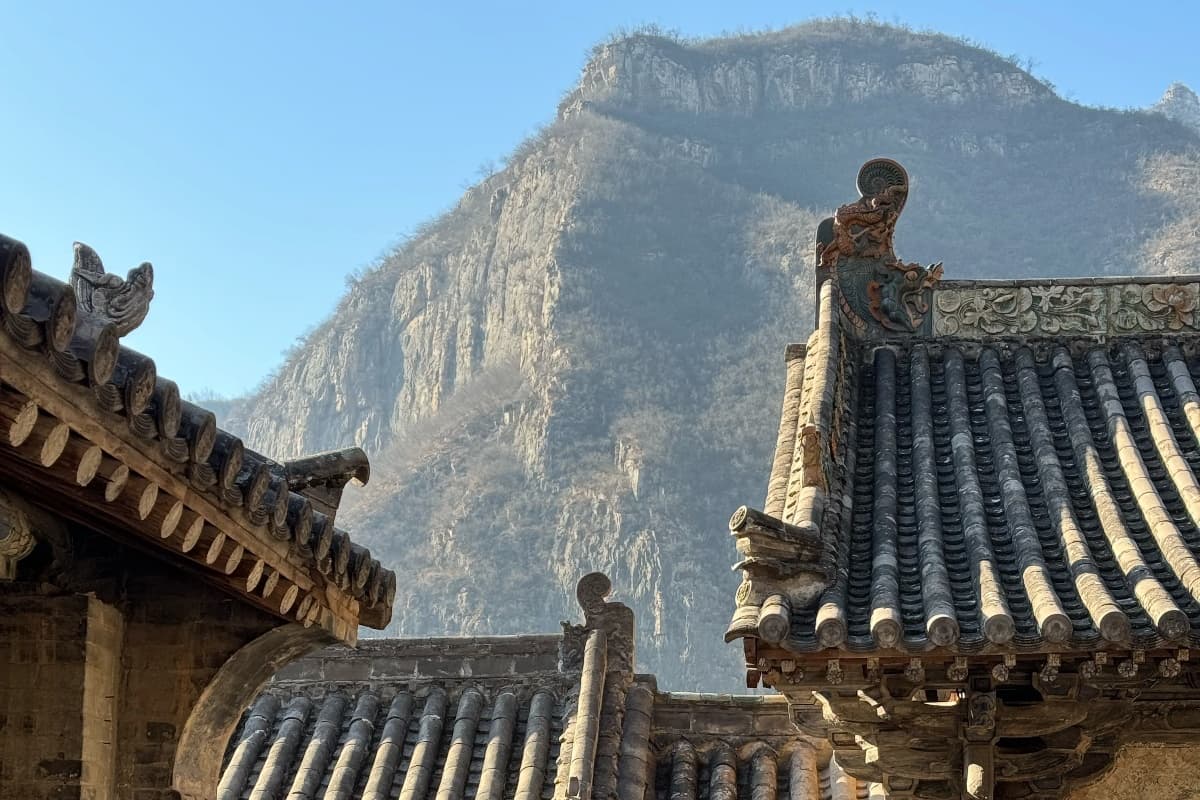
Dayun Temple: The Only Five Dynasties Murals Outside Dunhuang
An hour further into the Zhuo Zhang River valley, Dayun Temple (大云院) sits at the base of Dragon Ear Mountain, in a spot that local legend describes as "nine dragons playing with a pearl" — nine mountain ridges converging on a central hill, with the temple nestled at its base. Dayun Temple's fame rests on a single, extraordinary fact: it contains the only surviving Five Dynasties period (907-960 CE) murals outside of Dunhuang. Let that register. The entire thousand-year history of Chinese mural painting from this era is represented in exactly two places — the famous caves in the Gobi Desert, and this quiet temple in a Shanxi river valley that most people couldn't find on a map. The murals are faded — they're over a thousand years old, so that's expected — but what remains is breathtaking. Celestial maidens bearing flowers, heavenly figures in flowing robes, all painted with a fluidity and grace that the art historians call "walls of wind and painted immortals" (满壁风动画中仙). The brushwork has a confidence that comes from absolute mastery: single continuous lines that define entire figures, colour gradients achieved with techniques we can't fully replicate today. Our expert spent forty minutes with these murals, using a laser pointer to trace the narrative — it's a continuous story told in panels, like an ancient comic strip, depicting celestial gatherings and Buddhist teachings. Some sections are almost invisible to the untrained eye, the pigments having faded to barely-there whispers of colour. But once the expert shows you what to look for, figures emerge from the wall like ghosts materialising. It's genuinely spine-tingling. The local rhyme about Dayun Temple goes: "Shihui village, three li long, one temple every li, seventy-two connected caves, and nine dragons playing pearl at Dayun." Of the three temples mentioned in the rhyme, only Dayun survives. The others are gone. Every time I learn something like that about these sites, I feel the same mixture of gratitude that they survived and anxiety about how easily they might not have.
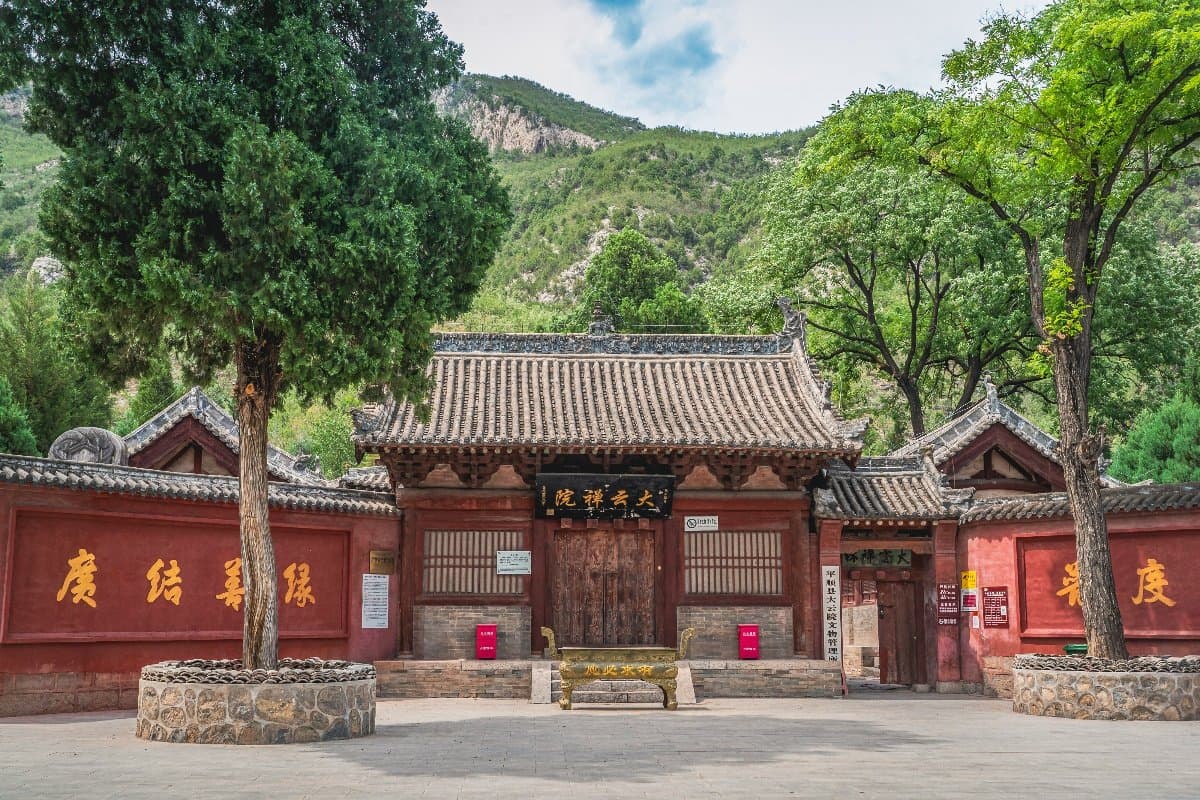
Tiantai Temple: A Five Dynasties Wooden Mystery
Not far from Dayun, also in the Zhuo Zhang River valley, Tiantai Temple (天台庵) is one of only four surviving wooden structures from the Five Dynasties period in all of China. Four. In a country of 1.4 billion people and five thousand years of civilisation, exactly four wooden buildings from this era are still standing. Tiantai Temple is one of them, and it's the smallest and most enigmatic. The main hall is compact — almost cottage-scale — with a simplicity that feels deliberate rather than modest. There are no Buddha statues inside (they were destroyed long ago), no paintings, no decorative flourishes. What you see is pure structure: columns, beams, bracket sets, and roof. It's architecture stripped to its essence, and for exactly that reason, it's become a pilgrimage site for anyone who cares about the craft of building. The mystery of Tiantai Temple is its exact date. The temple is associated with the Tiantai school of Buddhism, and records indicate it was built during the Later Tang period of the Five Dynasties (923-936 CE). But its bracket sets and structural details have sparked decades of scholarly debate — some experts argue certain features suggest an even earlier date, possibly late Tang. Our historian presented both arguments and let us draw our own conclusions. The ambiguity is part of the charm. This building has been asking questions for a thousand years and nobody has definitively answered them. The setting is lovely — a small rise beside the river, surrounded by farmland and mountains, with a quietness that feels earned rather than empty. A number of architecture enthusiasts were there the day we visited, sketchbooks in hand, carefully drawing bracket details. There's a community of people who travel enormous distances to study buildings like this. Standing among them, pencils scratching on paper, I understood the devotion.
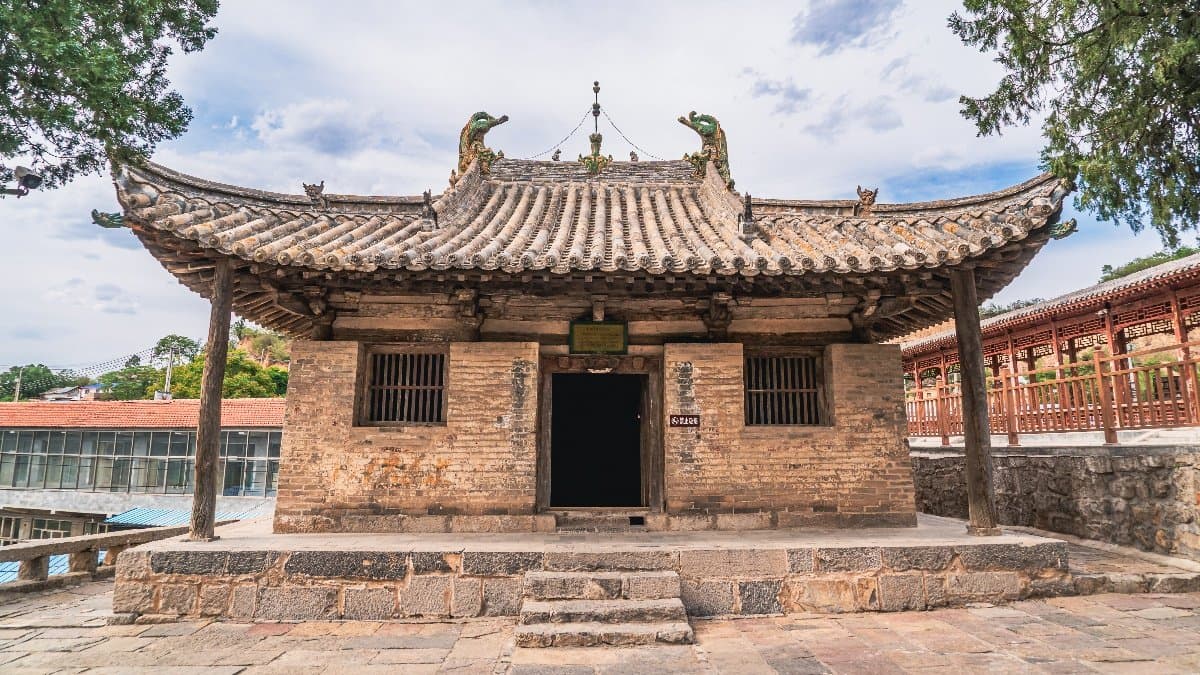
Book hotels in Changzhi — the best base for exploring the Zhuo Zhang River valley temples.
Prices compared via Trip.com. We may earn a commission at no extra cost to you.
Compare HotelsDay 5: Qinglian Temple — Five Dynasties to Qing in One Compound
The final morning brings Qinglian Temple (青莲寺), perched on a mountainside outside Jincheng with views that make you understand why someone chose this spot to build a monastery. To the east, the layered peaks of Fushan mountain. To the south, the twin summits of Jueshan, poking through the clouds like chopsticks standing in a rice bowl. Qinglian Temple is the greatest-hits compilation of the entire trip, compressed into a single compound. It has Tang dynasty painted sculptures, Song dynasty wooden halls, Yuan dynasty Buddha statues, Ming dynasty murals and side halls, and a Qing dynasty mountain gate. Five dynasties — Tang, Song, Yuan, Ming, and Qing — all present and accounted for, spanning roughly a thousand years of continuous construction, renovation, and worship. Walking through the compound chronologically is like fast-forwarding through Chinese architectural history at double speed. The upper and lower temples contain over a hundred stone steles with inscriptions spanning the dynasties — a library carved in stone. Ancient cypresses and ginkgo trees, some clearly centuries old, provide shade and a sense of botanical time that matches the architectural time around them. The overall atmosphere is one of deeply layered peace. Incense smoke drifts between buildings. Birdsong echoes off stone walls. There's a bench near the back of the upper temple where I sat for twenty minutes just looking at mountains and breathing. This is the trip's farewell temple — after Qinglian, it's a two-and-a-half-hour drive to Zhengzhou airport and the return to modern life. The timing feels right. Qinglian Temple doesn't hit you with any single overwhelming masterpiece the way Yutang's Constellations or Faxing's Enlightened Ones do. Instead, it offers perspective. You've spent four days immersed in individual moments of architectural genius; Qinglian Temple shows you the full sweep, the continuity, the fact that people have been building sacred spaces in these mountains for over a thousand years and never stopped.
Qinglian Temple is split into upper and lower sections. Don't skip the upper temple — it's a short uphill walk but contains the oldest structures and the best views. The ancient ginkgo tree in the courtyard is estimated to be over 1,000 years old.
Practical Info: What You Need to Know
This is a trip that rewards preparation, so here's everything you need to plan it properly. **Getting There** The tour starts and ends in Zhengzhou (郑州), which is one of China's best-connected transport hubs. Zhengzhou Xinzheng International Airport has flights from every major Chinese city, and Zhengzhou East railway station is a high-speed rail nexus with direct trains from Beijing (2.5 hours), Shanghai (4 hours), Xi'an (2 hours), and Guangzhou (5.5 hours). Fly in the day before the tour starts and fly out the evening it ends. **Price** The guided tour costs ¥3,780-4,680 per person depending on the departure date (holiday periods cost more). This includes four nights' accommodation (two nights in a five-star hotel in Changzhi), seven included meals, all temple entry fees, expert lectures at every site, transport throughout, and insurance. It does not include flights/trains to Zhengzhou, personal meals not listed in the itinerary, or personal expenses. **Group Size and Age** Maximum 20 people per group. Open to ages 25-50. The small group size matters — several of these temples have cramped interior halls where a large tour group would be chaos. **Physical Difficulty** This is not a hiking trip. Most temple visits involve short walks on flat ground. The Wang Mang Ridge section has about an hour of gentle walking along a paved path. The only mildly demanding bit is the uphill walk to Qinglian Temple's upper section. Anyone of reasonable fitness will be fine. **Best Season** Spring (April-May) and autumn (September-October) are ideal. Summer is hot and humid in the valleys. Winter is cold but the temples are dramatically atmospheric in snow — if you can handle the chill. **What to Bring** - Comfortable walking shoes (not hiking boots — you're on paved paths and temple floors) - A small flashlight or phone torch (some temple interiors are very dark) - Layers — mountain temperatures can shift significantly between valleys and ridges - A notebook — you'll want to write things down, trust me - Minimal camera gear — tripods are not allowed inside temples, and flash is forbidden **Language** The expert lectures and all guiding is in Chinese (Mandarin). There is currently no English-language option for this specific tour. If your Chinese is limited, consider hiring a local English-speaking guide as a supplement, or travelling with a Chinese-speaking friend who can translate the key points. **Booking** The tour is operated by Daocaoren Travel (稻草人旅行). Book through their official website or WeChat mini-program. Departure dates run from April through November, with the highest frequency in spring and autumn. Book early for holiday periods — the May Day Golden Week departures sell out fast. **Budget Tip** Midweek departures (usually Tuesdays or Wednesdays) are cheapest at ¥3,780. Avoid the May 1 Labour Day departure if budget is a priority — it peaks at ¥4,680.
Search flights to Zhengzhou — the cheapest gateway to Southeast Shanxi's ancient temples.
Prices compared via Trip.com. We may earn a commission at no extra cost to you.
Search FlightsThe Final Word
I've travelled a fair bit in China. I've done the Great Wall, the Terracotta Warriors, the Li River, the Bund. All brilliant, all worthy. But Southeast Shanxi gave me something none of those places did: the feeling of encountering something genuinely undiscovered. These temples aren't on postcards. They're not in guidebooks. They're not optimised for Instagram. They're just there, in their mountain valleys, being quietly extraordinary, protected by elderly guardians who've dedicated their lives to sweeping the same courtyards their parents swept. Black Myth Wukong brought these places to global attention, and for that the game deserves enormous credit. But the reality is richer than any game can capture. The weight of old wood under your hand. The smell of incense in a hall that's burned it for eight hundred years. The expression on a Song dynasty Bodhisattva's face that shifts depending on the light. The feeling of sitting in a temple guardian's courtyard, drinking tea, listening to a man describe his life's work of protecting something irreplaceable. Southeast Shanxi isn't the China you expect. It's the China that's been here all along, waiting for you to show up and pay attention. Go before the crowds figure it out.